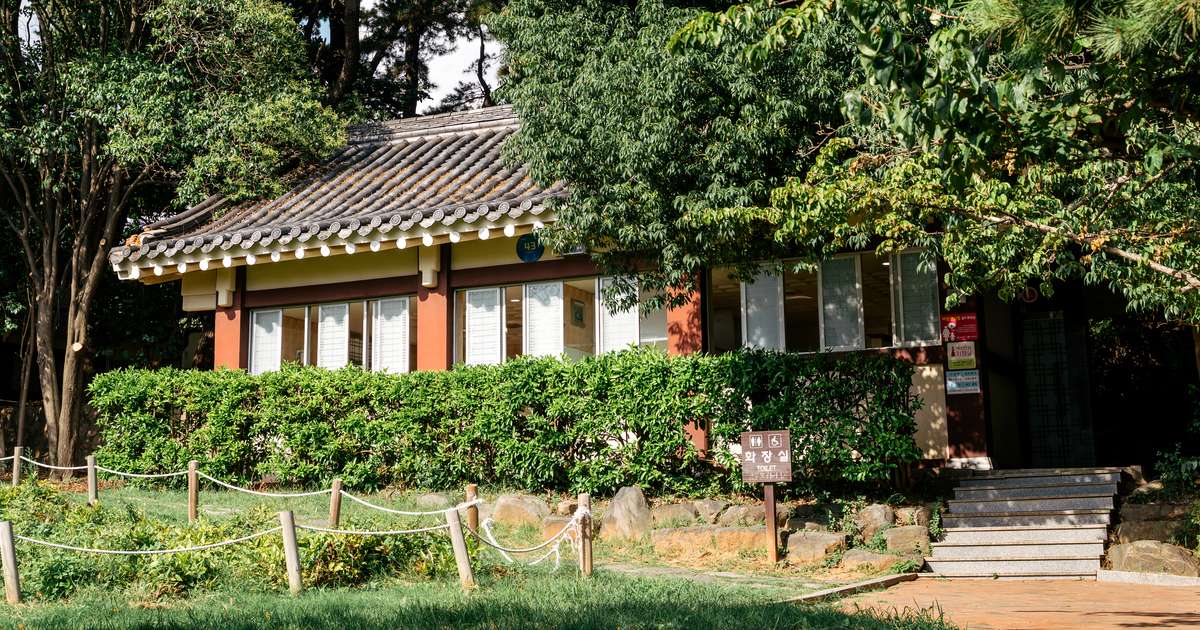
In a Korean public toilet, flush the paper. Since January 1, 2018, the law has told the people who run public toilets not to put a bin inside the stall at all, and that applies to old toilets as well as new ones. The bin you sometimes do see belongs to the accessible stall or the one with a baby-changing table. Hotels, guesthouses and Airbnbs are a different case: they sit outside the public-toilet law, so if your host has a sign asking you to bin the paper, follow the sign. The rest of this guide covers what goes where (pads, wipes), how to find a toilet fast, why most Seoul subway toilets are outside the fare gates and how to get back in without paying twice, and what to do about hidden cameras.
- Public toilets: flush the paper. The law has kept bins out of stalls since January 1, 2018.
- A bin in a stall usually means the accessible stall or the baby-changing one. Paper still goes in the toilet.
- Pads in the box in the stall, wet wipes in the bin by the sinks. Only toilet paper goes in the bowl.
- Hotels, guesthouses, Airbnbs: not covered by the law. Follow the sign.
- Seoul subway: toilets are mostly outside the gates. Tap out with a transit card and come back through the same station and line within 15 minutes for no second base fare.
- Suspicious device: leave, then call 112. The 1330 hotline can interpret.
Contents
- Who this is for
- Flush or bin?
- Why some stalls still have a bin
- Pads, tampons and wet wipes
- Which places count as public toilets
- Hotels, guesthouses and Airbnbs
- Finding a toilet fast
- Subway toilets: inside or outside the gates?
- Do I pay again to get back in?
- Hidden cameras: who checks, what to call
- Your situation
- Common mistakes
- FAQ
- If it were me
- Official sources
Who this is for
First-time visitors who’ve heard conflicting advice about toilet paper in Korea, and anyone who’ll be out all day on the subway.
- You’re used to binning paper at home or from travel elsewhere in Asia and don’t want to block a Korean toilet.
- You’re staying in an Airbnb or guesthouse and aren’t sure the public rule applies there.
- You’ll be riding the Seoul or Busan subway and want to know where the toilets are.
You can skip it if:
- You already know the public-toilet rule and only use your hotel bathroom.
In Korea, do I flush toilet paper or put it in the bin?
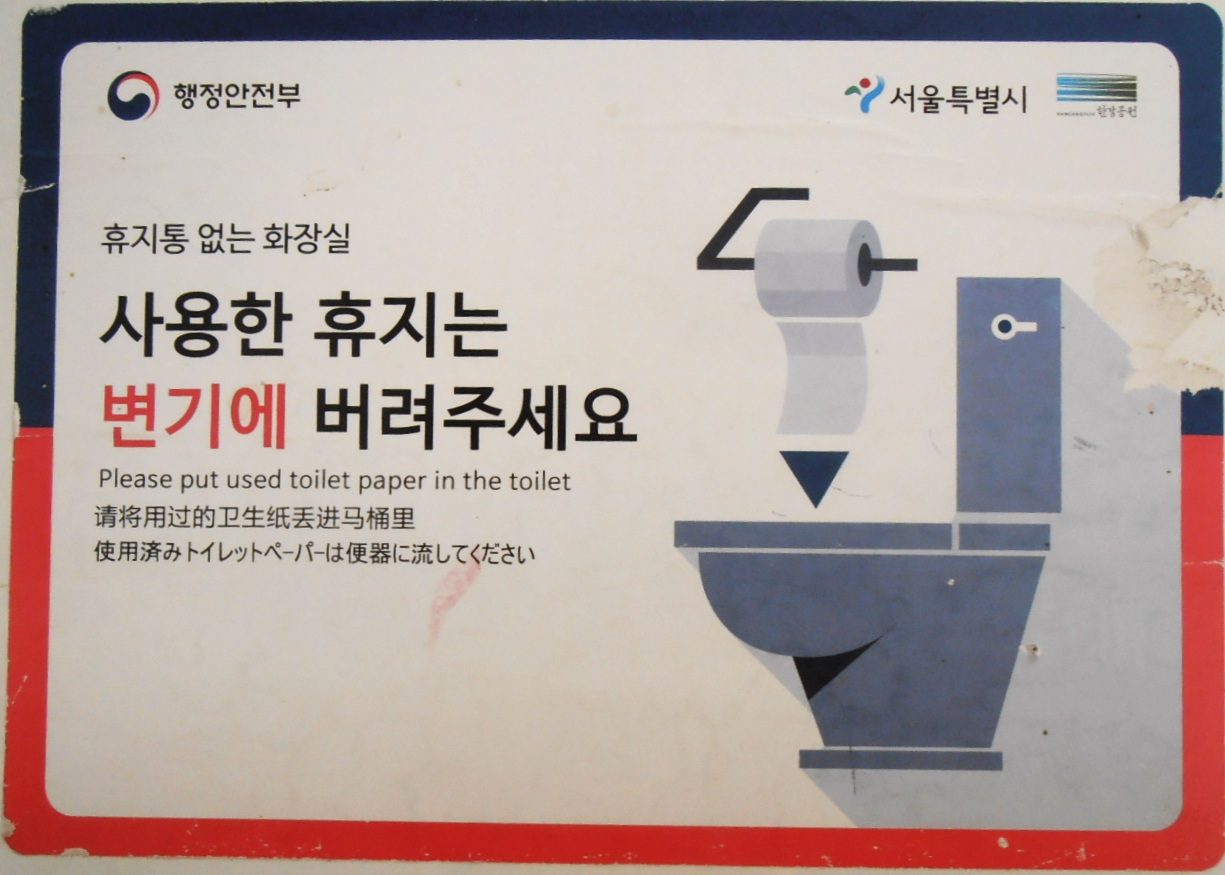
Flush it, in any public toilet. The Enforcement Decree of the Public Toilets Act sets management standards for public toilets, and one of them, in the official English translation, reads: “A waste bin shall not be installed in a water closet partition.” It took effect on January 1, 2018, and the standard isn’t limited to new buildings, so older toilets had to take their stall bins out too.
If you walk into a stall and there’s no bin, nobody forgot it. Put the used paper in the toilet and flush. Seoul’s own advice to residents is the same.
| Rule | No waste bin inside a toilet stall |
|---|---|
| Legal source | Enforcement Decree of the Public Toilets Act, Article 7 (management standards), item 3 |
| In force since | January 1, 2018; existing toilets included |
| Who the penalty targets | The toilet’s manager: an improvement order first, then a fine of up to ₩1,000,000. Not users. |
Then why do some stalls still have a bin?
Because the same rule has two exceptions. The decree lets a bin go into a stall in these two cases:
| Exception 1 | “Where a water closet is installed for the use of persons with disabilities, senior citizens, pregnant women, nursing mothers, etc.” (the accessible stall) |
|---|---|
| Exception 2 | “Where a diaper changing table for infants and young children is installed” |
So a bin in a public-toilet stall usually means it’s the accessible stall or the one with a baby-changing table. It’s there for diapers, and paper still goes in the toilet. A small lidded box in an ordinary women’s stall is something else, covered in the next section.
Where do pads, tampons and wet wipes go?
Pads go in the small box in the stall; wet wipes go in the bin by the sinks. Only toilet paper goes in the bowl. The decree requires “a box, etc. for collecting sanitary pads” in every women’s stall, unless the toilet is one where that isn’t needed, such as a children-only toilet. Seoul’s subway puts it the same way: paper in the toilet, sanitary products in the collection box, other trash in the bin by the washbasins.
| Item | Where it goes |
|---|---|
| Used toilet paper | The toilet |
| Pads, liners, tampons | The collection box in the women’s stall |
| Wet wipes, cotton swabs | The bin by the sinks, never the toilet |
| Wrappers, cups, other trash | The bin by the sinks |
Korea’s Ministry of Culture, Sports and Tourism has explained why: wet wipes, cotton swabs and sanitary products contain plastic, don’t break down in water and clog sewage treatment. Traveling with small children, I’d carry a zip bag for used wipes.
Which places count as public toilets?
Stations, airports, bus terminals, big stores and malls, parks and tourist sites, rest areas, public buildings, and private buildings above a certain size. These are the places in Article 3 of the Public Toilets Act and its decree that visitors use most.
| Place | Examples you’ll pass through |
|---|---|
| Rail and subway stations | Seoul and Busan subway stations |
| Airports | Incheon, Gimpo, Gimhae |
| Bus terminals | Express and intercity bus terminals |
| Large stores and shopping arcades | Department stores, hypermarkets, underground shopping streets |
| Urban parks, nature parks, tourist sites | Hangang parks, national parks |
| Rest areas and gas stations | Highway rest areas |
| Public facilities | Government offices, exhibition halls, zoos and botanical gardens, hospitals, libraries |
| Larger private buildings | Buildings with 2,000 ㎡ or more of shops, restaurants and offices combined, among others |
That last row means a café or restaurant inside a big commercial building may be using a toilet that counts as public, and you can’t tell from outside. My rule of thumb anywhere: if there’s a sign, follow the sign; if there’s no sign and no bin, flush.
Is it the same in hotels, guesthouses and Airbnbs?
No. Hotels, guesthouses and Airbnbs aren’t covered by the public-toilet law, so follow the sign in the bathroom. Hotel rooms, guesthouses, short-term rentals and private homes aren’t on the act’s list, so the no-bin standard doesn’t apply to them. That doesn’t mean you must bin the paper there; it means each property sets its own rule, usually because of its plumbing.
| Where you are | Toilet paper goes |
|---|---|
| Public toilets (subway, airport, department store, park) | In the toilet; no bin in the stall by law |
| Hotel room | Follow the sign in the bathroom |
| Guesthouse, Airbnb, private home | Follow the host’s sign or instructions; if there’s nothing, ask |
In a rental, the trash is the next thing you’ll deal with; see whether you sort trash in Korean hotels and rentals. Before booking one, it’s also worth checking whether the listing is registered.
Where do I find a toilet in a hurry?
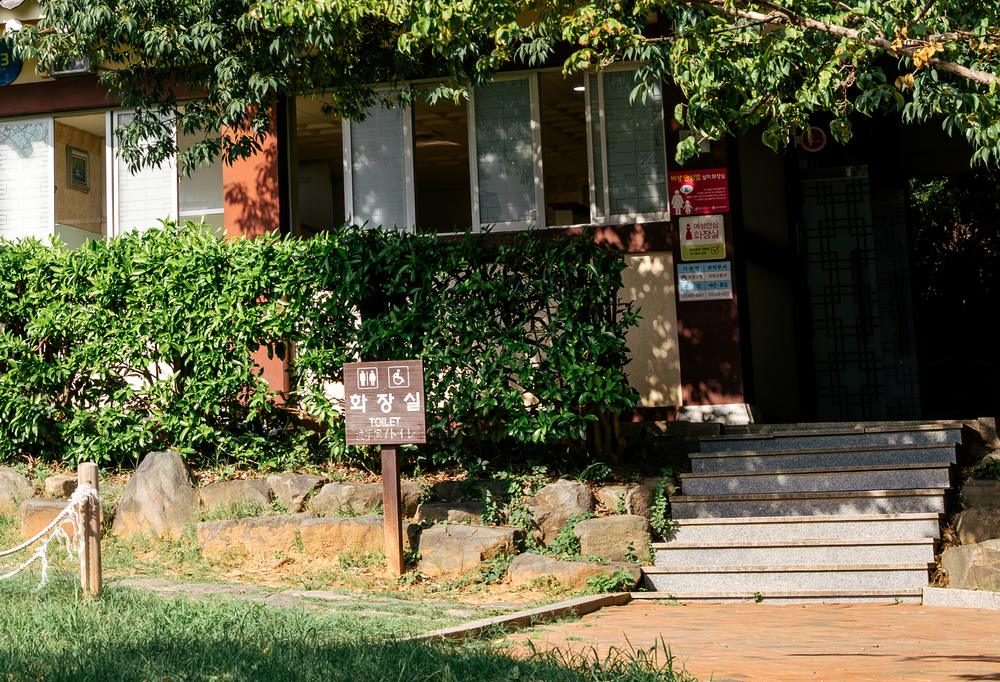
Open Naver Map or Kakao Map and search “화장실” (toilet). That’s what Seoul tells its own residents to do. Copy the Korean word; it’s also what’s printed on most toilet signs.
- Seoul’s public-toilet layer: Seoul’s own Smart Seoul Map (Korean interface) shows public toilets under 도시생활지도 (city life map) → 공중화장실 (public toilets).
- “Open toilet” signs: local governments designate some toilets in public and private buildings as 개방화장실 (open toilets), and the act requires a sign where the public can see it. If you see one at a building entrance, walk in.
- No signal: head for the kinds of places in the table above: a subway station, department store, underground shopping street, park or library.
Are subway toilets inside or outside the fare gates?
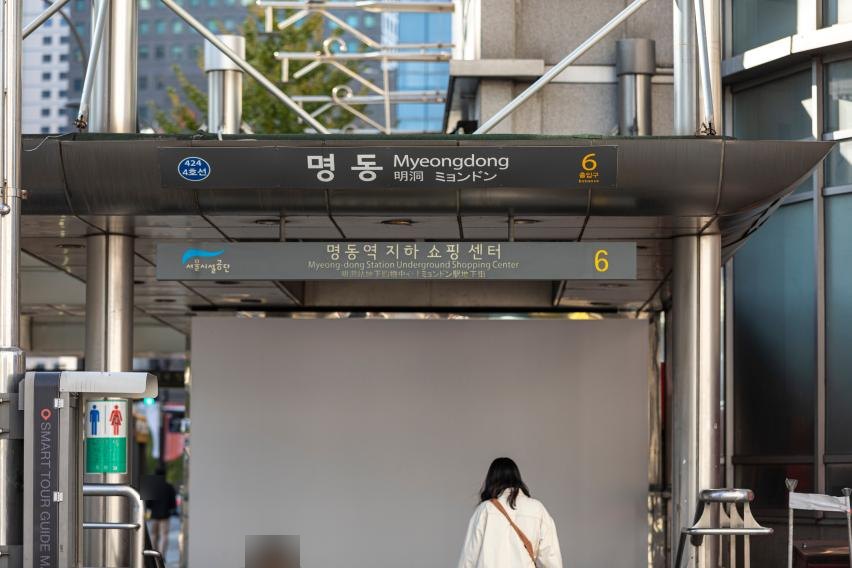
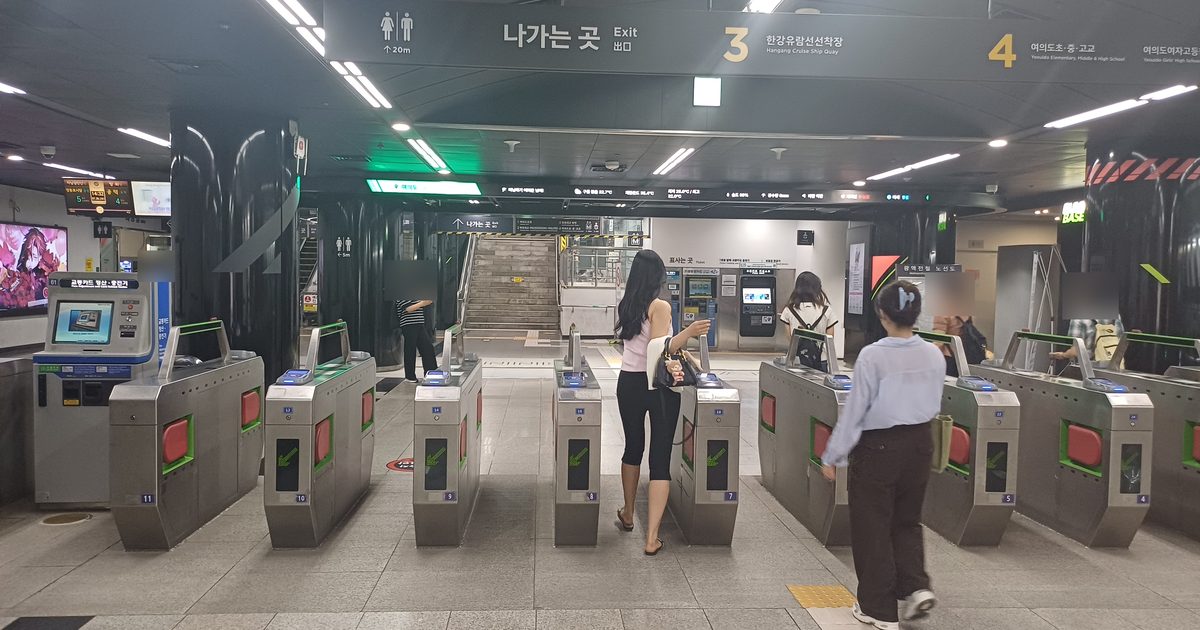
Mostly outside. Seoul counted 256 of the 313 stations on Lines 1–9 (82%) with toilets outside the platform area, and at 51 of the 275 Seoul Metro stations on Lines 1–8 the toilet is more than 100 m from the gates. In Busan, the operator’s station data lists toilets outside the gates at 105 of 108 stations on Lines 1–4.
These are the stations visitors use most, with the station names each operator uses in English:
| Station | Line | Toilet |
|---|---|---|
| Seoul (data as of February 12, 2026) | ||
| Seoul Station | 1, 4 | Outside |
| Myeong-dong | 4 | Inside |
| Hongik Univ. | 2 | Outside |
| Dongdaemun History & Culture Park | 2 | Inside |
| Dongdaemun History & Culture Park | 4 | One inside, one outside |
| Dongdaemun History & Culture Park | 5 | Outside |
| Gangnam | 2 | Inside |
| Jamsil | 2, 8 | Outside |
| Gyeongbokgung | 3 | Inside |
| Anguk | 3 | Outside |
| Yeouinaru | 5 | Outside |
| Busan (data as of June 30, 2025) | ||
| Seomyeon | 1, 2 | Outside |
| Nampo, Jagalchi, Busan Station | 1 | Outside |
| Haeundae, Gwangan, Centum City | 2 | Outside |
For any other station, follow the “화장실” signs after you get off; by the time you reach the gates you’ll know whether you need to tap out.
Do I pay again if I leave the subway to use the toilet?
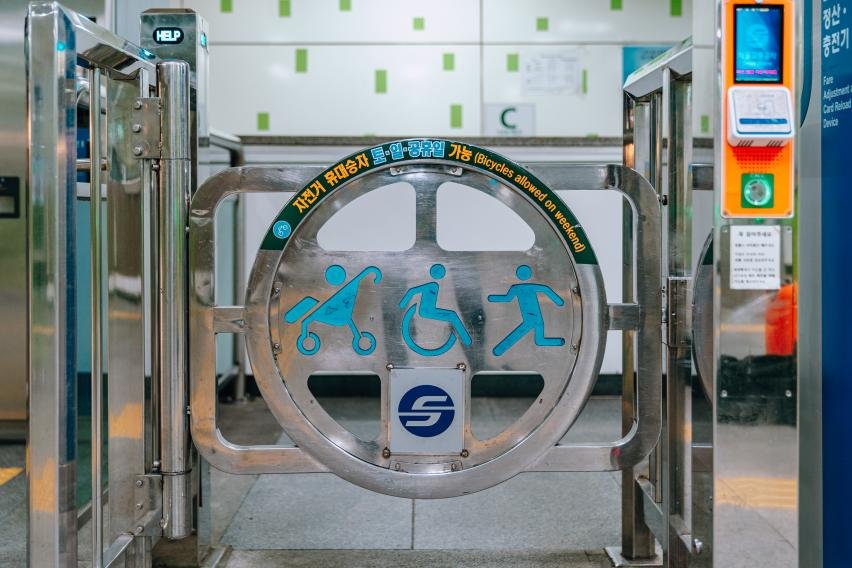
Not in the Seoul area, if you use a transit card: tap out, come back through the same station on the same line within 15 minutes, and you won’t be charged a second base fare. The system treats it as a transfer, and any distance-based extra is charged as usual. Seoul’s lines have had this since October 7, 2023; KORAIL-run lines in the Seoul area joined on June 20, 2026.
| Seoul lines | Seoul Metro Lines 1–8, Line 9, Ui-Sinseol Line, Sillim Line (since October 7, 2023) |
|---|---|
| KORAIL lines in the Seoul area | Since June 20, 2026 |
| Time limit | 15 minutes after tapping out |
| Where to re-enter | The same station, the same line |
| Ticket | Transit cards such as T-money; not single-journey tickets or commuter passes |
| How often | Once per trip |
| Not covered | AREX (the airport railroad), Shinbundang Line and other privately run lines |
This is a Seoul-area rule. In Busan, ask the station staff before you tap out, or wait until you exit at your destination. If you’re coming in from Incheon Airport on AREX, I’d use the airport toilet before boarding, since that line isn’t covered.
- Check you’re using a transit card, not a single-journey ticket.
- Tap out and note the time.
- Come back to the same station within 15 minutes and tap in at a gate for the same line.
Hidden cameras in toilets: who checks, and what number do I call?
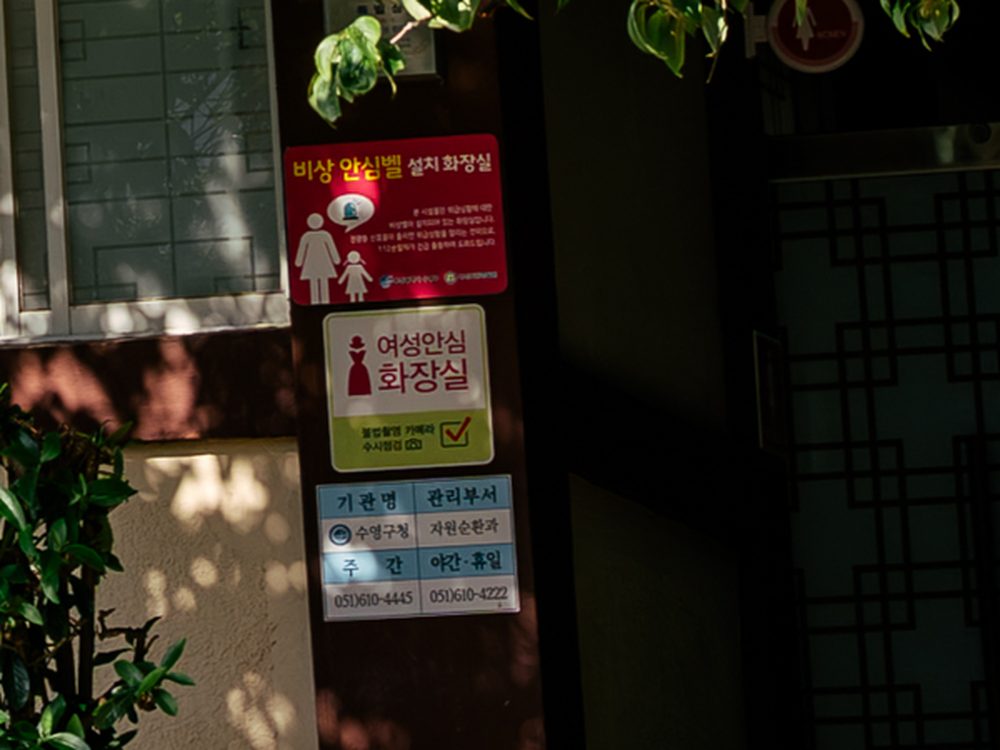
Local governments inspect public toilets at least twice a year, including for cameras; if you spot a suspicious hole or device, leave first, then call 112. Article 12 of the Public Toilets Act requires those regular inspections, and in the official English translation, “inspections shall be conducted on whether a camera or other similar mechanical devices are installed inside public toilets.”
| Who checks | The city, county or district government |
|---|---|
| How often | At least twice a year |
| Emergency bell | Installed in public toilets designated by local ordinance; it connects straight to the manager or the local police |
| From February 12, 2027 | The law adds hidden-camera detection systems alongside emergency bells, and police can ask local governments to fix problems |
| Private toilets | Not on the regular inspection list; local governments lend detectors when the owner asks |
| Report a crime | 112 (police) |
| English help | 1330, the Korea Tourism Organization travel hotline, which can join a three-way call with emergency services, 7 a.m. to midnight |
The inspection duty covers public toilets, not every toilet. A café or restaurant toilet outside the act isn’t checked on a schedule. If your Korean isn’t up to a police call, ring 1330 and ask them to bring 112 into the call.
Your situation
If you need a toilet on the Seoul subway with several stops to go
Get off at the next station and follow the “화장실” signs. If the toilet is inside the gates, go. If it’s outside, tap out with your transit card and come back through a gate for the same line within 15 minutes. At a transfer station, remember which line’s gate you left from. On AREX or the Shinbundang Line, the 15-minute rule doesn’t apply.
If you’re on the Busan subway
Expect to tap out: almost every station has its toilet outside the gates, including both lines at Seomyeon. Ask the station staff about re-entry before you leave, or hold on until the station where you were getting off anyway.
If you’re shopping in Hongdae or Myeong-dong and can’t see a toilet
Search “화장실” on Naver Map or Kakao Map, or walk into the nearest subway station, department store or underground shopping street. A building with an “개방화장실” sign at the door lets the public in.
If your Airbnb bathroom has a bin and no sign
Message the host and ask. If you can’t reach them, bin the paper for that stay; it costs nothing and won’t block an unfamiliar drain.
Common mistakes
- Seeing a bin in an accessible stall and binning everything. That bin is for diapers; paper still goes in the toilet.
- Flushing wet wipes. They contain plastic and don’t break down in water. Use the bin by the sinks.
- Assuming the public rule covers your Airbnb. It doesn’t; the host’s sign decides.
- Tapping out with a single-journey ticket to use the toilet. The 15-minute re-entry only works with a transit card.
- Re-entering through a different line’s gate. It has to be the same station and the same line.
- Expecting the 15-minute rule on AREX or in Busan. It’s for Seoul-area lines run by Seoul and KORAIL.
- Worrying about a fine for binning paper. The penalty targets the toilet’s manager, not you.
FAQ
- Q1: Do you flush toilet paper in Korea?
- Yes, in public toilets. Since January 1, 2018, the Enforcement Decree of the Public Toilets Act has told managers not to put a waste bin inside the stall, so used paper goes in the bowl.
- Q2: Why is there a bin in some Korean toilet stalls?
- The law allows two exceptions: the accessible stall and a stall with a baby-changing table. That bin is mainly for diapers; paper still goes in the toilet.
- Q3: Where do pads and tampons go in a Korean public toilet?
- In the small collection box inside the stall. Women’s stalls are required to have one. Wet wipes and other trash go in the bin by the sinks, never in the toilet.
- Q4: Do I flush toilet paper in a Korean hotel or Airbnb?
- Follow the sign in the bathroom. Hotels, guesthouses and Airbnbs aren’t covered by the Public Toilets Act; if there’s no sign, ask the host.
- Q5: Are Seoul subway toilets inside or outside the gates?
- Mostly outside. Seoul counted 256 of 313 stations on Lines 1–9 with toilets outside the platform area. With a transit card, coming back through the same station on the same line within 15 minutes doesn’t cost a second base fare.
- Q6: Can I be fined for putting toilet paper in the bin in Korea?
- No. The no-bin rule is aimed at the people who run public toilets, not users. The penalty is an improvement order and then a fine on the manager.
- Q7: What number do I call if I find a hidden camera in a Korean toilet?
- 112, the police. If you need English help, the Korea Tourism Organization’s 1330 hotline can join the call as an interpreter, 7 a.m. to midnight.
If it were me
In any public toilet, I’d flush the paper without thinking twice; the law is clear and it’s been in force since 2018. In a hotel I’d glance at the wall for a sign, and in an Airbnb I’d ask the host on day one rather than guess. On a full day in Seoul, I’d use the toilet before leaving the hotel and again at big stations like Seoul Station or a department store, and only rely on the 15-minute re-entry when I’m caught mid-ride. In Busan, I’d plan stops at my destination station, since almost every toilet there is outside the gates. And I’d save 112 and 1330 in my phone before the trip.
Official sources
- Korea Legislation Research Institute: Enforcement Decree of the Public Toilets Act (official English translation; no-bin rule, exceptions, sanitary-pad boxes, scope)
- Korea Legislation Research Institute: Public Toilets Act (official English translation; Article 3 scope, Article 7 emergency bells, Article 12 inspections)
- Ministry of Land, Infrastructure and Transport: 15-minute re-entry on KORAIL lines (Korean)
- UK Foreign Office travel advice: South Korea, getting help (1330 hotline hours and three-way calls)
Prices and times follow the latest official announcement.
Read next
Verified
 Current
Korea Garbage Rules 2026: Trash Bags, Pickup Times, Fines
Each district sets its own rules. In an Airbnb, general waste goes in that district’s paid volume-based bag (sold at convenience stores and supermarkets) and out by your own door on the district’s evenings; in Jeju it goes to a neighborhood clean house, open 15:00–04:00. In a hotel you do not sort. Putting household trash out wrong is a KRW 100,000 fine.
Verified
 Current
Do Korean Hotels Provide Toothbrushes? The 2026 50-Room Rule
Since March 29, 2024, Korean lodging businesses with 50 or more guest rooms and all public bathhouses, including jjimjilbang, may not give out disposable toothbrushes, toothpaste, razors, shampoo or conditioner for free; selling them is allowed. Slippers, towels and body wash are not covered, and hotels under 50 rooms, homestays and hanok stays are not bound by the rule.
Verified
 Current
Is Airbnb Legal in Korea? 2026 Registration Check for Guests
Being on Airbnb isn’t a license: a Korean listing is legal when the home is registered with its district office as a lodging business. Since October 16, 2025, Korean listings without a submitted license can’t take bookings for stays from January 1, 2026; the Registration Details at the bottom of the listing description show Region of Issuance, License Type and License Number. Officetels can’t be registered as urban guesthouses. The penalties target operators, not guests; if the host cancels, you get a full refund.