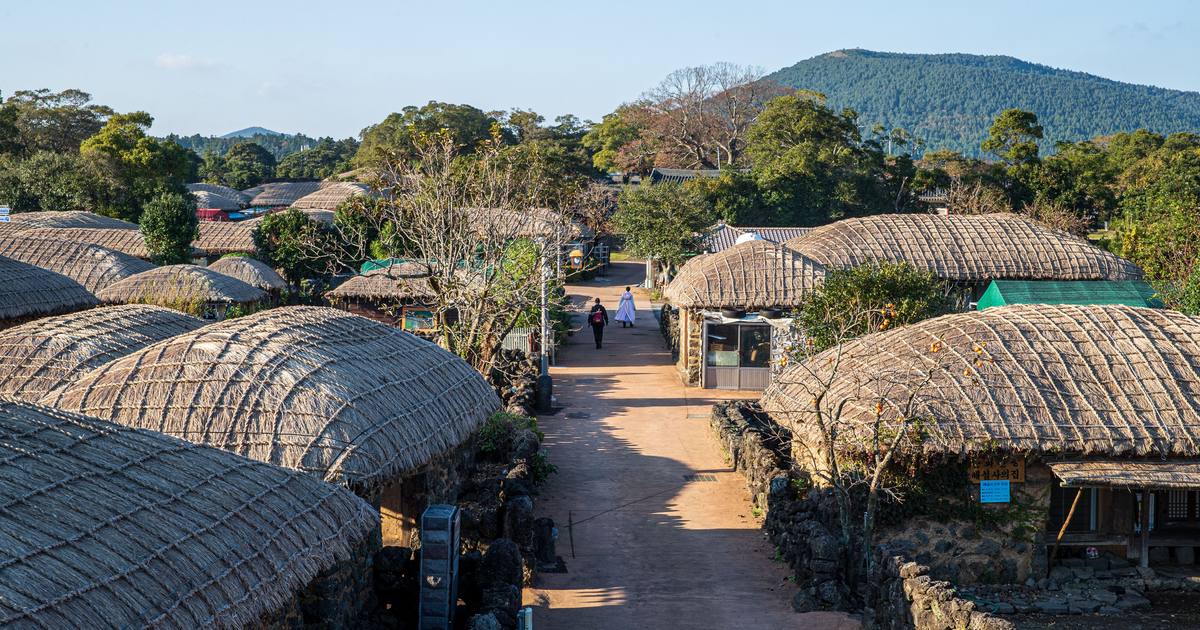
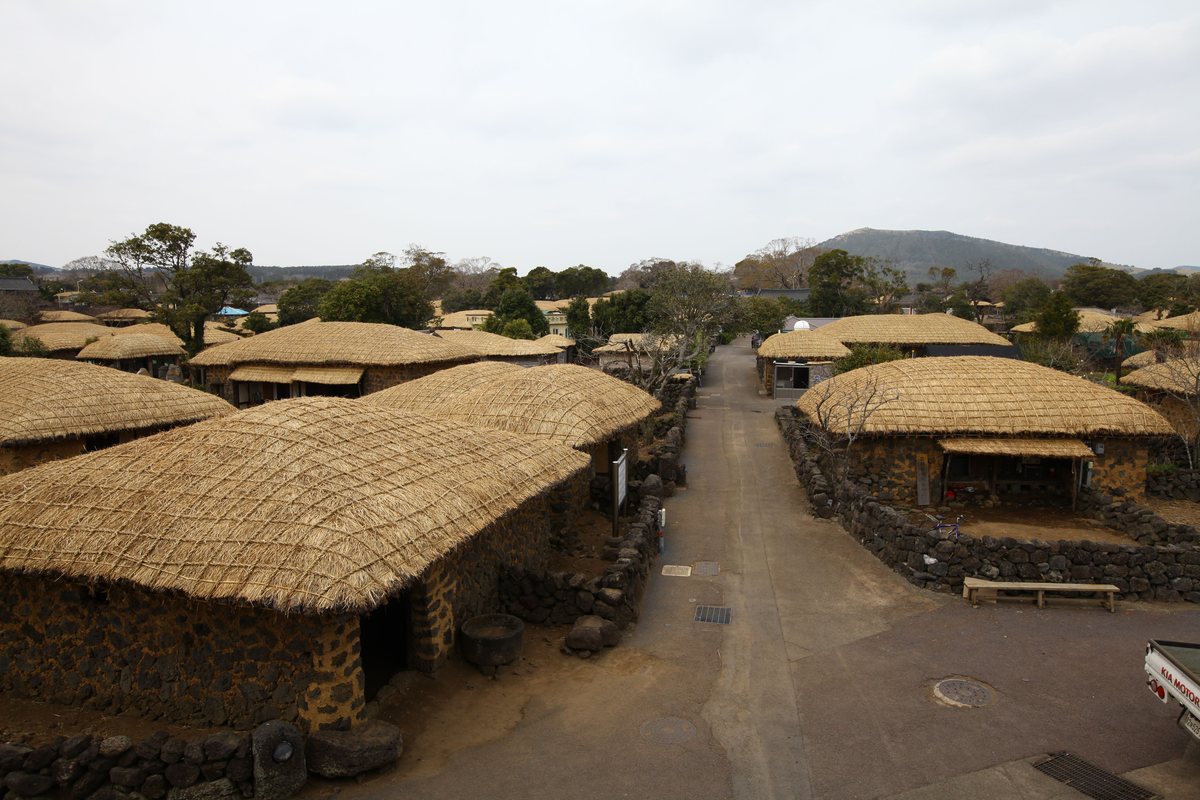
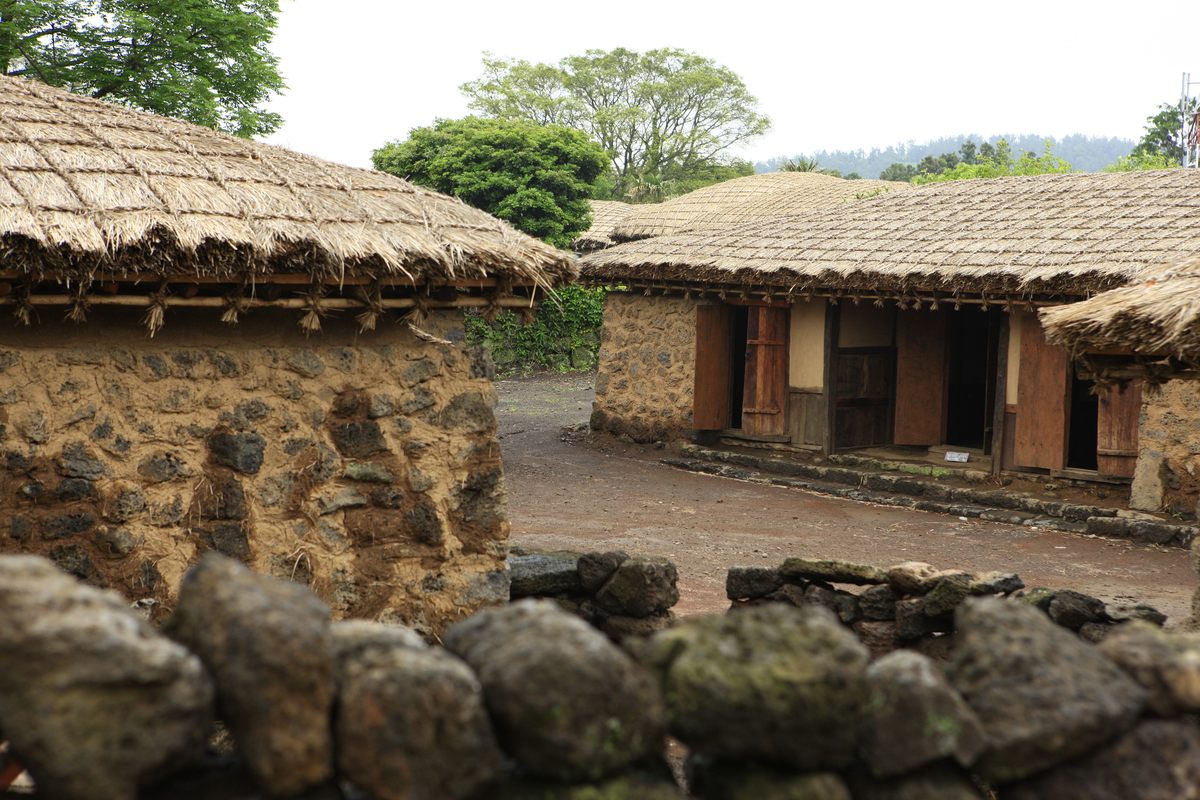
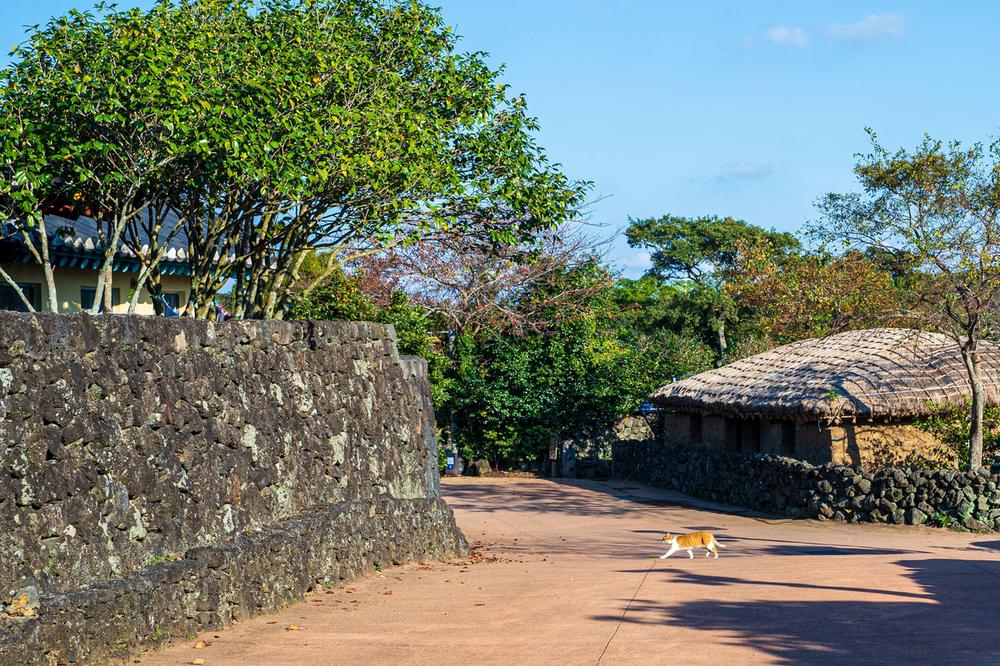
Seongeup Folk Village costs nothing to enter and has no opening or closing time; the village suggests about 1 hour and asks you to arrive before dark. It is also not Jeju Folk Village. That one is a paid open-air museum on the coast at Pyoseon, at the end of the same bus routes, so staying on the bus too long takes you to the wrong place. Seongeup is a real village where people live, inside old basalt walls, with thatched houses lining the lanes. Free guided walks run daily from 10:00 to 17:00, given by interpreters employed by Jeju Province, and the village states they never sell anything. Below: whether it deserves a slot in your east Jeju day, how to get there without a car, and what the guides and the shops are. Bus stops and destination signs are in Korean: Seongeup is 성읍, Jeju Folk Village is 제주민속촌.
- Free, no opening hours: about 1 hour, arrive before dark.
- Free official guides: daily 10:00–17:00, about 60 minutes, last start 16:00. Call +82-64-710-6810 or sign up at the interpreters’ office. Languages aren’t stated, so ask.
- The guides don’t sell: horse-bone and omija products come from private shops on the village’s own list.
- Not Jeju Folk Village: that’s the paid museum at the end of the same bus routes.
- Without a car: pair it with Geomunoreum; buses 221, 222, 121 and 122 stop at both.
- Not World Heritage: “UNESCO” in a tour name refers to the other stops that day.
Contents
- Who this is for
- Seongeup or Jeju Folk Village?
- Admission and hours
- The free guides
- Who sells the horse-bone products?
- Is it worth it, and for how long?
- By bus
- Pairing it with Geomunoreum, Seongsan, Manjanggul
- In winter
- Day tours that stop here
- Your situation
- Common mistakes
- What I would do
- FAQ
- If it were me
- Official sources
Who this is for
Travelers with a day in eastern Jeju deciding whether Seongeup earns a place in it.
- You don’t drive and want a free stop in the east that buses can link up.
- Your day tour lists “Seongeup Folk Village” and you want to know what happens there.
- You want to see Jeju’s thatched roofs and stone-walled lanes without paying for a park.
- You can’t tell Seongeup Folk Village from Jeju Folk Village.
You can skip it if:
- You have one day in the east, it’s already full with Seongsan Ilchulbong, Manjanggul and the haenyeo show, and you don’t drive. Seongeup and Manjanggul don’t share a bus route.
- You want performances or a festival: there are no regular performances in winter.
- You want a tidy, curated open-air museum. That’s Jeju Folk Village, not Seongeup.
Is Seongeup Folk Village the same as Jeju Folk Village?
No. One is a lived-in village with free entry; the other is a paid open-air museum on the Pyoseon coast. Both names have “folk village” in them and both sit on the same bus routes, which is why people mix them up. The bus is the easiest way to remember: on 221, 222, 121 and 122 toward 제주민속촌, Seongeup is a stop along the way, and the last stop is the paid museum.
| Seongeup Folk Village (성읍민속마을) | Jeju Folk Village (제주민속촌) | |
|---|---|---|
| What it is | A lived-in village, designated National Folklore Cultural Heritage in June 1984 | A paid open-air museum on the Pyoseon coast |
| Address | 서귀포시 표선면 성읍정의현로 30, Pyoseon, Seogwipo; for car navigation, 서성일로 20 | 서귀포시 표선면 민속해안로 631-34, on the Pyoseon coast |
| Admission | Free | Adult ₩15,000, senior ₩13,000, youth ₩12,000, child ₩11,000 |
| Bus | A stop partway along 221, 222, 121, 122 | The end of the same routes |
One more mix-up: Seongeup isn’t a World Heritage site. Jeju’s UNESCO World Natural Heritage covers Hallasan, Seongsan Ilchulbong and the Geomunoreum lava tube system. When a day tour is called a “UNESCO” tour, that’s about the other stops.
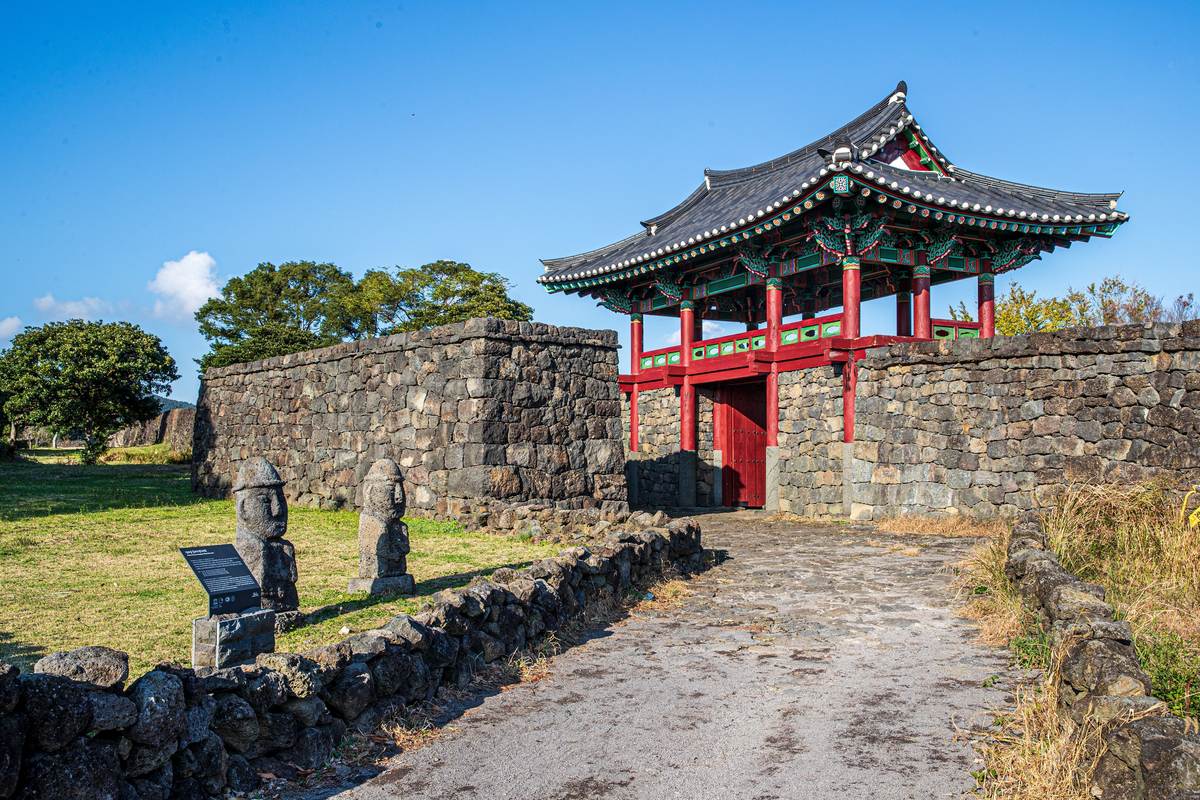
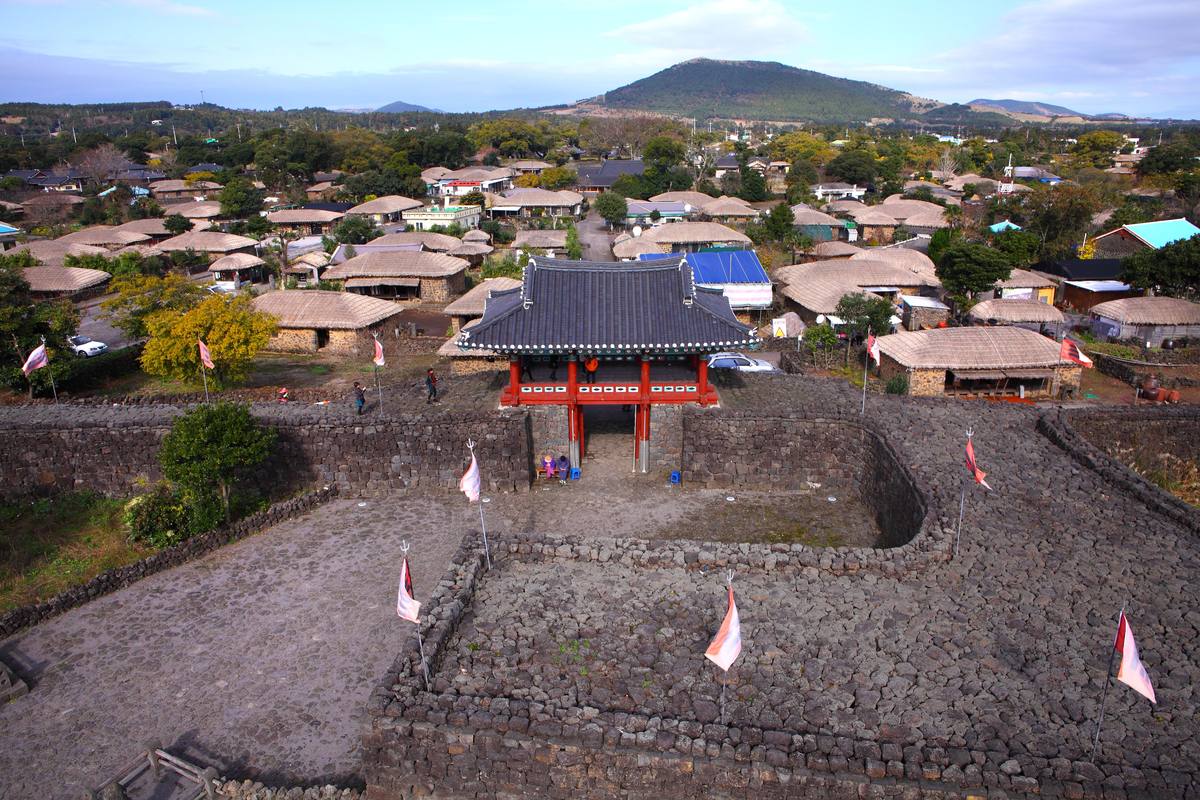
Is it free? What are the opening hours?
It’s free and has no opening hours, so come whenever you like, but before dark. The village site says it’s hard to see anything once it gets dark. If you’ve seen “operating hours 10:00–17:00,” including on the Korea Tourism Organization’s English page, that’s the guides’ schedule; the village itself never closes.
| Admission | Free |
|---|---|
| Opening hours | None; no entry cut-off |
| Official advice | Arrive before dark |
| Suggested stay | 1 hour (village site); 1–2 hours (Visit Jeju) |
| Closed days | None |
| Parking | Free; the intangible heritage center lot has 43 large and 90 small spaces |
| Pets | Allowed |
| Designated old houses | Usually open, but may be closed for the owners’ reasons |
| Free guides | Daily 10:00–17:00; see the next section |
That last row matters. Seongeup is where people live, and the village site lists several designated heritage houses that are normally open to look at but may be closed when the owners need them. If a door is shut, or someone is working in the yard, don’t walk in.
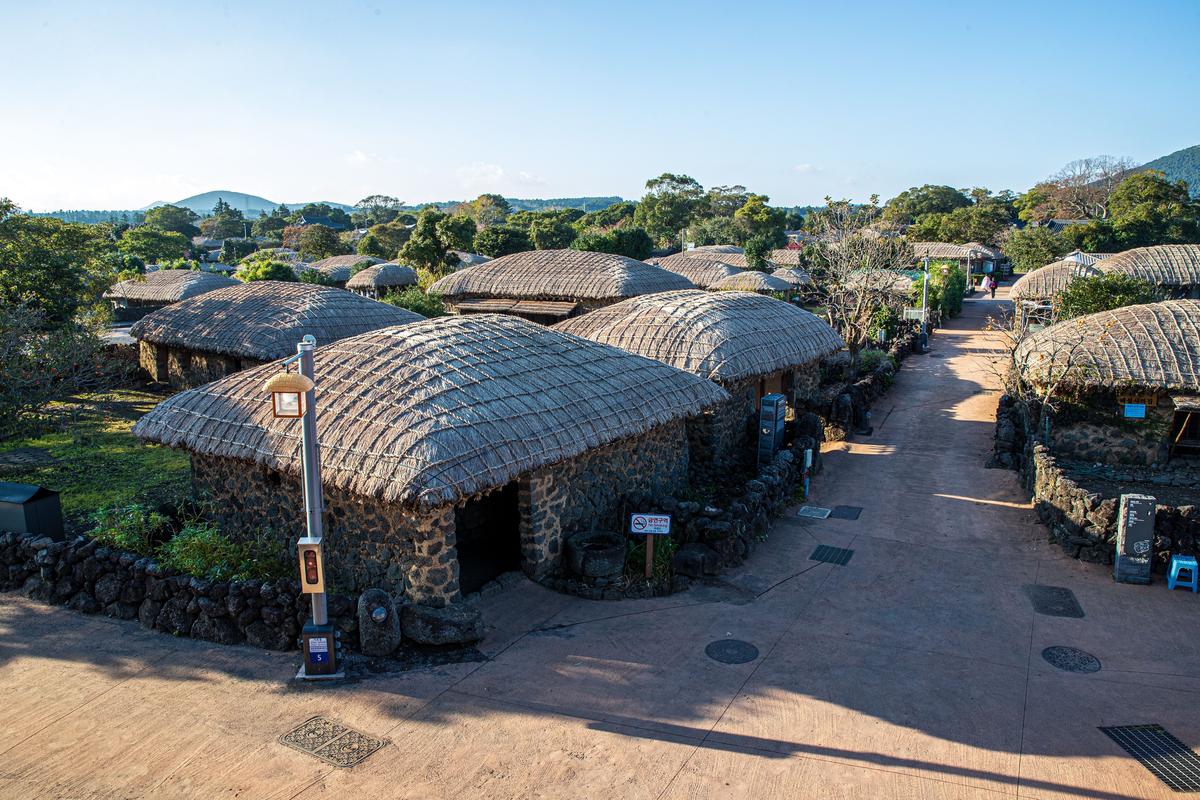
Is there a free guide, and do they speak English?
There are free guides every day, employed by Jeju Province, and the village doesn’t say which languages they speak. They’re called culture and tourism interpreters (문화관광해설사), and the village site states that they never introduce or sell products of any kind. Seongeup’s details, like how the thatch is tied down and why a county seat stood here, are easy to miss on your own, so a guide adds the most here if you can follow one.
| Cost | Free, every day |
|---|---|
| Hours | 10:00–17:00, lunch break 12:00–13:00 |
| Length | About 60 minutes; last start 16:00 |
| Booking | Phone +82-64-710-6810, or sign up at the interpreters’ office |
| Language | Not stated; ask when you call |
| Official statement | The province’s interpreters never introduce or sell products |
How to get a guided walk:
- Pick a time: from 10:00, or a start between 13:00 and 16:00. In winter it gets dark early, so in the afternoon I’d take a start before 15:00.
- Call +82-64-710-6810 and ask whether an English guide is available and where to meet. You can also just turn up at the interpreters’ office and sign up.
- Be at the meeting point on time and walk with the guide for about 60 minutes.
The phone is answered in Korean, so if you don’t speak it, get a Korean speaker to call for you or use your hotel’s front desk. If the guide turns out to be Korean only and you don’t speak Korean, an hour of it isn’t worth much; walk the village yourself and keep the time.
Who sells the horse-bone powder and omija tea?
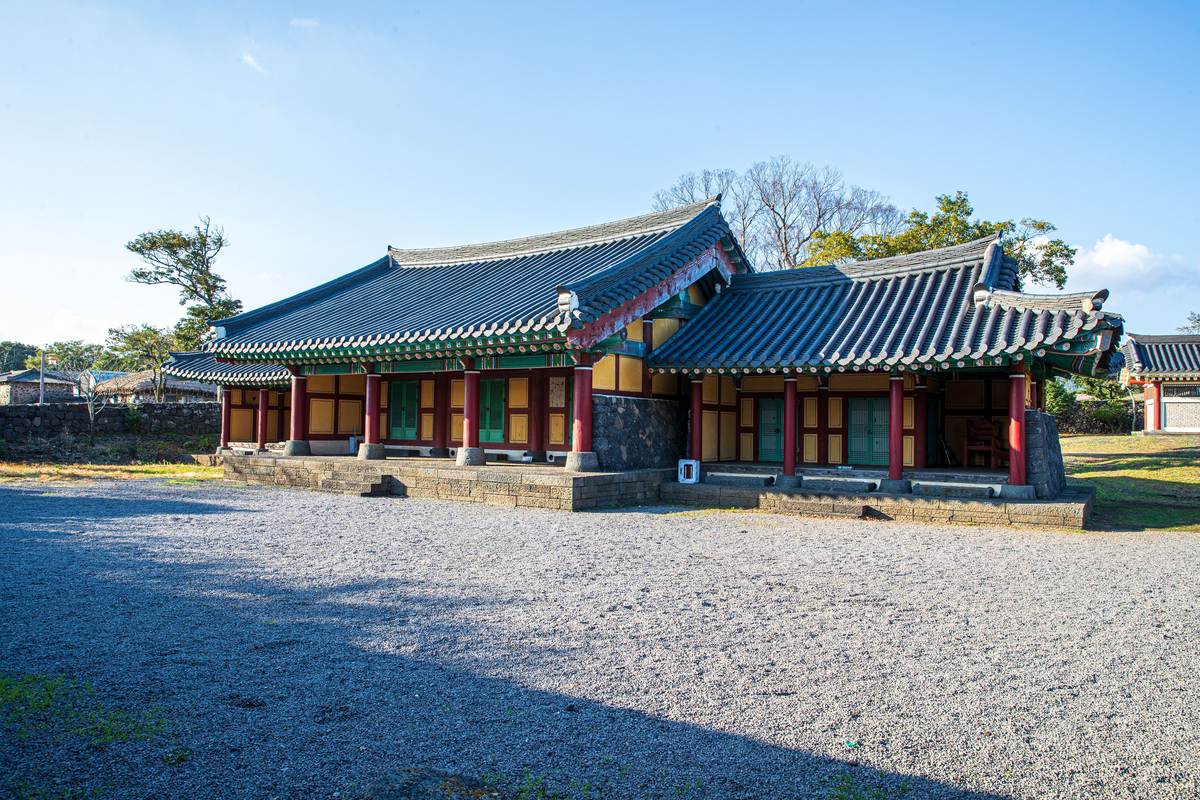
Private specialty shops. The village’s own shop list names 36 of them, separate from the guides. So yes, horse-bone products are sold in Seongeup, by shops on the village’s list. Whether you buy is up to you; nothing requires visitors to buy anything.
| On the village list | Number |
|---|---|
| Specialty shops (특산품판매점) | 36 |
| South Gate arcade (남문상가) | 22 |
| Souvenir shops | 5 |
| Restaurants | 54 |
Only the first specialty shop on the list names its products: fernbrake, omija tea, horse bone (pills, extract, powder), grubs (pills, extract, powder), horse oil cream and horse oil. The contact on that row is the village preservation society (성읍민속마을보존회), +82-64-787-1179. The other rows leave products blank, so you can’t assume all 36 sell the same things. Prices, health claims and returns aren’t on the list either; ask before you pay.
Put the two official facts together and the line is simple: the province’s guides explain and don’t sell; the shops sell and aren’t part of the guide program. If someone walks you into a house for a talk and it ends in a product pitch, that isn’t the province’s guide. Say thanks and leave; nobody can make you buy. To be sure you’re getting the official guide, book through the phone number above.
Is Seongeup Folk Village worth it, and how long do I need?
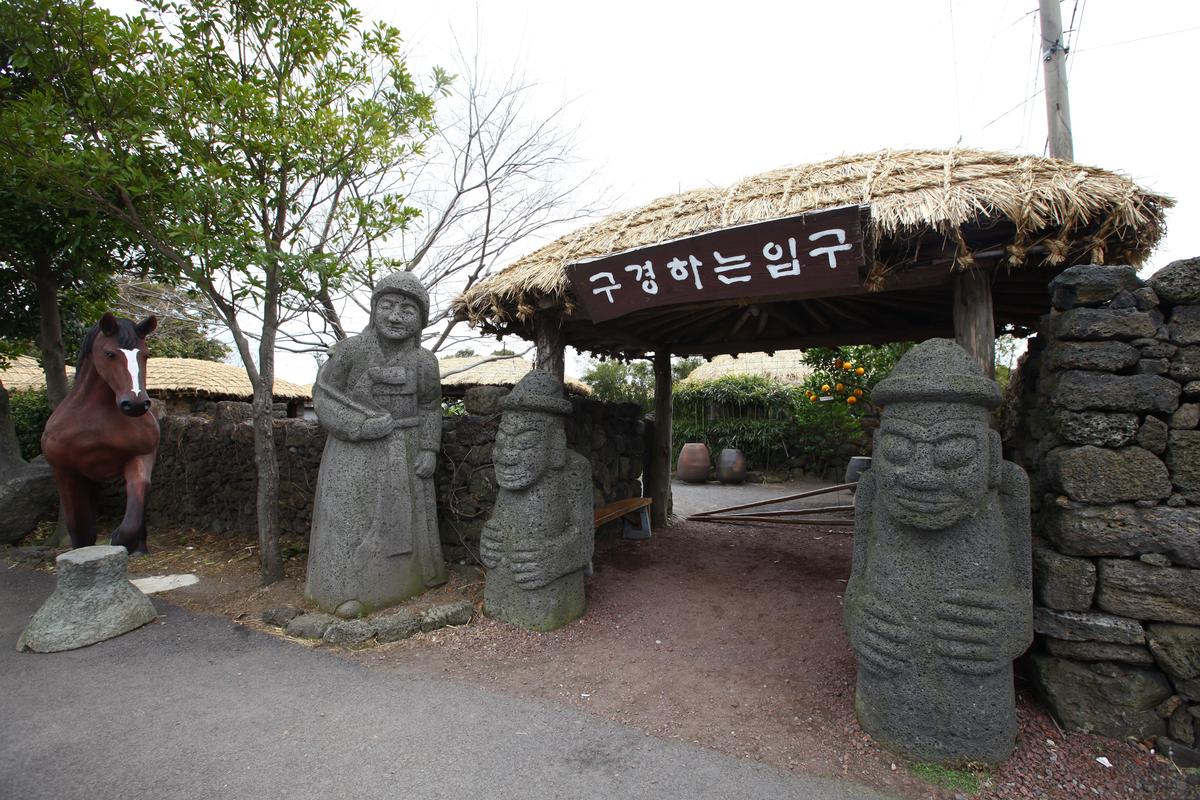
Worth a place in your east Jeju day, not worth a trip on its own. It’s free, never closes and sits on the road between Geomunoreum and Pyoseon, so it fills a one- to two-hour gap well. It has no headline sight like Seongsan Ilchulbong or Manjanggul, though, and I wouldn’t ride an hour each way from Jeju City or Seogwipo for it alone.
Timing: about 1 hour walking on your own, as the village suggests; 1.5 to 2 hours with a guided walk. If a guide in a language you follow is available, book one. If not, keep it to an hour.
How do I get to Seongeup Folk Village by bus?
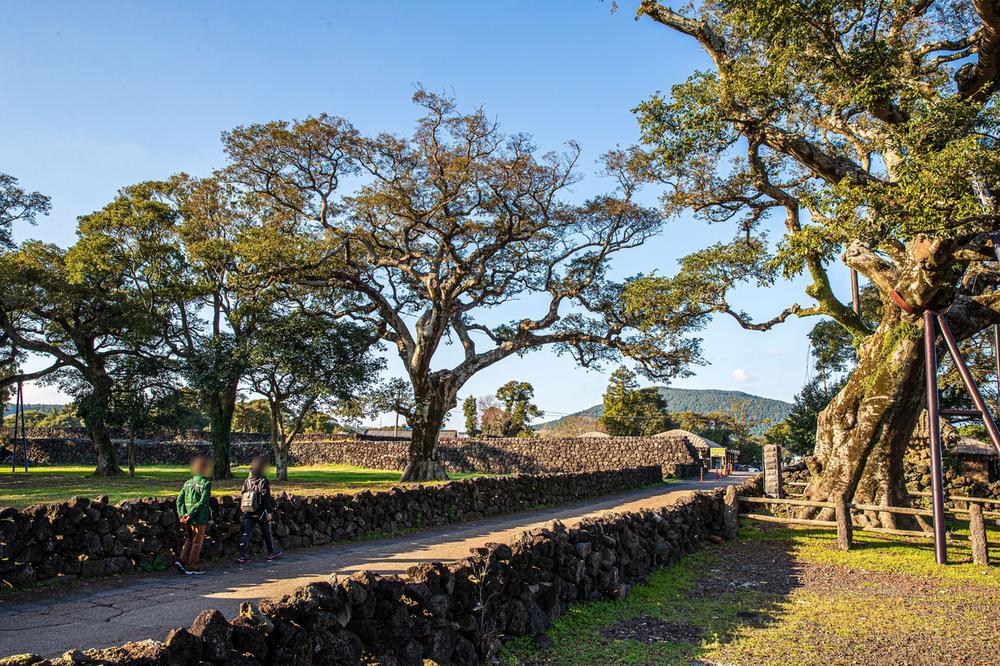
From Jeju City it’s one bus: express 121 or 122 from the airport, or trunk 221 or 222 from Jeju Bus Terminal, toward 제주민속촌, about 55 minutes. From Seongsan or Seogwipo you change buses or wait for infrequent ones. How to pay on Jeju buses is in paying for Jeju buses with a card or cash.
| From | How |
|---|---|
| Jeju Airport | Express 121 or 122 toward 제주민속촌, get off at 성읍1리사무소; about 53–57 min; 15 runs each way a day |
| Jeju Bus Terminal | Trunk 221 or 222 toward 제주민속촌, get off at 성읍1리; about 54–58 min; 29 runs each way, every 30–75 min |
| Pyoseon | 221, 222, 121 or 122 northbound, 11–16 min |
| Seongsan (Goseong transfer stop) | 722-1 or 722-2 to 성읍문화마을, 55–60 min; on weekdays fixed runs only from morning to noon, then on-demand buses (옵서버스) 14:00–20:30 |
| Seongsan or Seogwipo | Bus 201 to Pyoseon (every 15–22 min), then any of the routes above northbound |
| Last bus back | To Jeju Bus Terminal: 221 from Seongeup at 22:47. To the airport: 122 from Seongeup at 20:38, arriving 21:32 |
Two things trip people up. The airport buses 121 and 122 run only 15 times a day, so missing one can mean an hour’s wait; check the timetable before you leave. From the bus terminal, 221 and 222 run about twice as often and are far more forgiving. And from Seongsan in the afternoon, the 722 switches to on-demand on weekdays, so take the 201 to Pyoseon and change instead. If you’re heading for a flight, the last 122 to the airport leaves Seongeup at 20:38; later buses only go to the terminal.
Can I pair it with Geomunoreum, Seongsan Ilchulbong or Manjanggul?
Without a car, Geomunoreum is the natural pair. Manjanggul doesn’t connect by bus, and Seongsan needs a change or a wait. Routes 221, 222, 121 and 122 all stop at 거문오름입구 (Geomunoreum entrance), so after the hike you wait at the same stop for a southbound bus and ride straight to Seongeup.
| Pair | By bus |
|---|---|
| Geomunoreum + Seongeup | Easiest: same routes, southbound from the Geomunoreum stop. Geomunoreum needs booking |
| Seongsan Ilchulbong + Seongeup | Possible with a change or a wait: 722 direct (on-demand on weekday afternoons), or 201 to Pyoseon then north |
| Manjanggul + Seongeup | Not worth it: no shared bus route |
| Jeju Folk Village + Seongeup | Same routes, but Jeju Folk Village charges admission |
Geomunoreum has to be booked in advance; when bookings open and how foreigners sign in are in Geomunoreum booking, Manjanggul and Seongsan. If you want Seongsan, Manjanggul and Seongeup all in one day, drive or take a day tour; for driving, see renting a car in Jeju.
What is Seongeup like in winter?
Still free, still guided; what changes is early darkness and no regular performances. The village doesn’t close, but it asks for arrival before dark, so in winter put Seongeup in the early afternoon.
| Guides | Daily 10:00–17:00 as usual, last start 16:00 |
|---|---|
| Performances | The 2026 Jeonguihyeon magistrate procession (정의현감 행차) ran only on the third Saturday of April, May, June and September at 13:00, and the folk festival in early October is over. No regular performances in winter |
| Thatched roofs | Replaced every 2 years between October and December, so in early winter some roofs may be under repair |
| Hands-on classes | The two traditional liquor classes (omegi-sul and gosori-sul) run March to October only |
So in winter, you’re there for the village and the guided walk, not for a show. For more to fill an east Jeju winter day, see where to see camellias in Jeju and tangerine picking in Jeju.
Which Jeju day tours stop at Seongeup Folk Village?
Several east Jeju day tours list Seongeup as a sightseeing stop, and none of the three below lists a shopping stop. Seongsan Ilchulbong, Manjanggul and Seongeup in one day is a combination buses can’t manage and a tour can. On a tour you’re free to walk the village on your own, and the KKday tour listings give about 50 minutes for the Seongeup stop. The official guided walk runs about 60 minutes, so on a tour I’d skip it and explore alone.
- Jeju Eastern UNESCO Sites Tour on KKday: Seongeup at 11:00, then lunch, Seongsan Ilchulbong, the haenyeo show and museum, tangerine picking, Gwangchigi Beach and Dongmun Market. English or Mandarin guide; free cancellation up to 2 days before; main entrance fees included; not for children under 4.
- Klook Jeju day tour, package B – East: Manjanggul, Seongeup, lunch, Seongsan Ilchulbong, the Haenyeo Museum and show, tangerine picking and Gwangchigi Beach. Choose package B; packages A and C go west and south and skip Seongeup. The page says “No forced shopping.”
- East Jeju day tour from Seogwipo and Jungmun on KKday: for travelers staying in the south, with pickups in Jungmun and Seogwipo; Seongeup at 12:05, then lunch, Seongsan and the haenyeo show. English or Mandarin; free cancellation up to 2 days before; lunch not included; not wheelchair accessible.
Haenyeo show times and cancellations are in Seongsan haenyeo show times.
Your situation
If you don’t drive and stay in Jeju City
Do your booked Geomunoreum hike in the morning, then wait at 거문오름입구 for a southbound 221, 222, 121 or 122 to Seongeup. In the afternoon, join a guided walk if you’ve confirmed a language you follow, and leave before dark: south to Pyoseon in 11–16 minutes, or back to the terminal on the 221, whose last run leaves Seongeup at 22:47.
If you’re on a day tour that stops here
Walk it yourself. Start with the stone-walled lanes and thatched houses, then decide whether to step into a shop. If a talk inside a house turns into a sales pitch, thank them and leave. For the official guided walk, come back on your own another day.
If you’re staying in Seogwipo
Getting here means the 201 to Pyoseon and a change, which adds up. Don’t make a trip for Seongeup alone: fold it into a Pyoseon and Seongsan day, or use the Seogwipo-pickup tour above.
If you’re driving
Parking is free, and Seongeup fits mid-day in an east-side loop: Seongsan or Manjanggul in the morning, an hour in Seongeup around noon, more stops in the afternoon. For a guided walk, arrive between 10:00 and 12:00 or between 13:00 and 16:00.
Common mistakes
- Staying on the bus to the end. The last stop, 제주민속촌, is the paid Jeju Folk Village. Get off at 성읍.
- Treating 10:00–17:00 as closing time. Those are the guides’ hours. And the reverse: the village never closes, but arrive late and you’ll see little once it’s dark.
- Calling it World Heritage. It’s National Folklore Cultural Heritage; “UNESCO” in a tour name means the other stops.
- Walking into homes. People live here; if a door is shut or someone is working, stay outside.
- Taking the 722 from Seongsan in the afternoon. After 14:00 on weekdays it’s on-demand; go via Pyoseon on the 201.
- Booking the guide without asking about language. It isn’t stated; ask before you spend the hour.
- Pairing Manjanggul and Seongeup without a car. No shared bus route; pair it with Geomunoreum.
What I would do
Without a car: Geomunoreum in the morning, Seongeup in the afternoon, on one bus line with no transfers.
| When | Plan |
|---|---|
| Before the trip | Book a morning Geomunoreum slot |
| A day or two before | Have someone call +82-64-710-6810 to book a 13:00 or 14:00 guided walk and ask about English and the meeting point. If it’s Korean only, cancel and plan to walk alone |
| Morning | 221 or 222 from Jeju Bus Terminal toward 제주민속촌; get off at 거문오름입구 for the hike |
| Around noon | Back to the same stop, southbound on the same routes to 성읍1리; lunch in the village |
| Afternoon | The guided walk, or an hour on your own; then half an hour in the side lanes |
| Before dark | 221 or 222 back to the terminal, or south to Pyoseon |
Two things in one day; Seongsan and Manjanggul go to another day, or to a tour.
FAQ
- Q1: Is Seongeup Folk Village free?
- Yes. There’s no admission fee and parking is free. Only the hands-on classes in the village cost money.
- Q2: Is Seongeup Folk Village the same as Jeju Folk Village?
- No. Seongeup is a lived-in village with free entry; Jeju Folk Village is a paid open-air museum on the Pyoseon coast, ₩15,000 for adults. Both are on the same bus routes: Seongeup is a stop along the way, Jeju Folk Village is the end of the line.
- Q3: What are Seongeup Folk Village’s opening hours?
- It has none; you can walk in at any time, but the village asks you to come before dark. The 10:00–17:00 you may see listed is the schedule of the free guides, with the last tour starting at 16:00.
- Q4: Is there an English guide at Seongeup Folk Village?
- The village doesn’t say which languages its guides speak. Call +82-64-710-6810 before you go and ask; if the answer is Korean only, walk the village on your own.
- Q5: Do the guides at Seongeup try to sell you things?
- The province’s guides don’t. The village site states that its culture and tourism interpreters never introduce or sell products. The horse-bone and omija products come from private shops in the village.
- Q6: How do I get to Seongeup Folk Village by bus from Jeju Airport?
- Take express bus 121 or 122 toward 제주민속촌 and get off at 성읍1리사무소, about 53–57 minutes. There are 15 runs each way a day. From Jeju Bus Terminal, routes 221 and 222 run about twice as often.
- Q7: How long should I spend at Seongeup Folk Village?
- The village suggests 1 hour. With a 60-minute guided walk, allow 1.5 to 2 hours.
If it were me
Without a car, I’d put Seongeup right after Geomunoreum and try for a guided walk; if the guide spoke only Korean, I’d walk for an hour and not sit through it. Driving, it’s an easy mid-day stop in the east: free, free parking, no hours to work around. On a tour, I wouldn’t switch tours because Seongeup is on it; I’d walk the lanes, browse the shops if I felt like it, and move on. The one case where I’d drop it: one day in the east, no car, and both Seongsan Ilchulbong and Manjanggul on the list. Then Seongeup is the first thing to cut.
Official sources
- Seongeup Folk Village official site (admission, hours, interpreter phone; Korean)
- 2026 culture and tourism interpreter notice (Korean)
- Seongeup shop list (specialty shops, souvenirs, restaurants; Korean)
- Jeju bus information (timetables for 221, 222, 121, 122, 722, 201)
- Visit Jeju: Jeju Folk Village (admission prices for the Pyoseon museum; Korean)
Prices and times follow the latest official announcement.
Official wording (Korean)
- Visiting information: 「관람시간 : 따로없음 / 소요시간 : 1시간 / 입장료 : 없음」, 「단, 해지기전에 오세요. 어두워서 관람이 어렵습니다.」
- Interpreters: 「제주특별자치도 소속 문화관광해설사는 상품안내 및 권유 등 일체의 상행위를 절대 하지 않습니다」
Read next
Verified
 Current
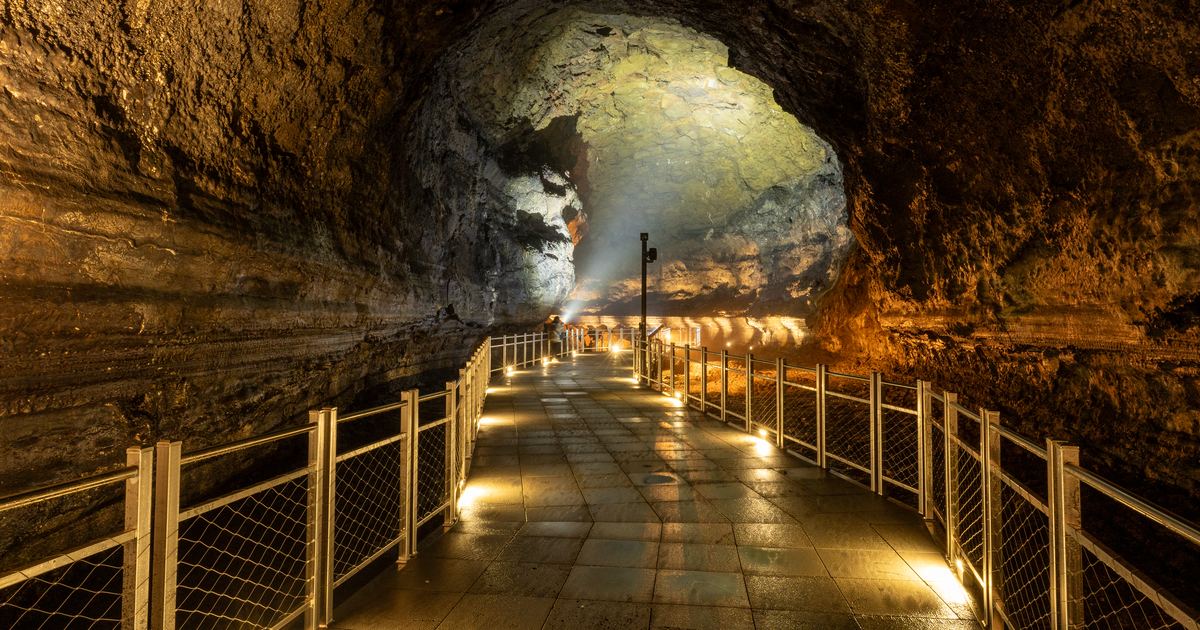
Manjanggul Lava Tube Reopened 2026: Hours, Geomunoreum Booking
Manjanggul Lava Tube reopened on May 30, 2026: tickets and entry 09:00–17:00, closed the first Wednesday of each month. Geomunoreum still needs a booking, opening at 09:00 KST on the 1st of the month before; foreigners use the Foreigners Only page with a Google login. It’s closed every Tuesday, last group 14:00. Seongsan Ilchulbong is open 06:00–18:00 November–February, closed the first Monday of each month.
Verified
 Current
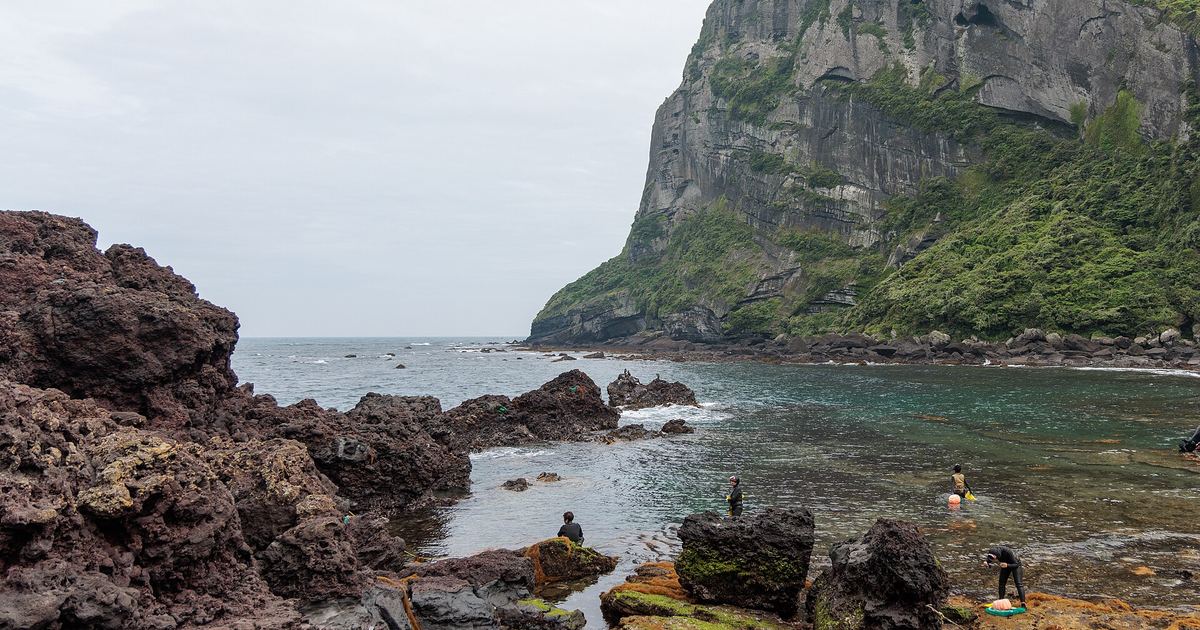
Haenyeo Show Jeju 2026: Time, Cost and Cancellations
The Seongsanpo haenyeo show runs once a day at 2 p.m. on Umutgae shore beside Seongsan Ilchulbong and is free; weather and conditions can change the time or cancel it, so call +82-64-783-1135 before you go. The backup is the Jeju Haenyeo Museum, 09:00–18:00 with tickets until 17:00, closed every Monday and on January 1, Seollal day and Chuseok day.
Verified
 Current
Jeju Bus Payment 2027: Visa Tap, T-money, No Cash
Jeju route buses have taken no cash since October 1, 2024. Since August 1, 2025, a second terminal for foreign visitors (ON나라페이) takes contactless Visa and QR payments; Jeju names no other card network. Otherwise use T-money or another nationwide transit card, including one bought in Seoul. The Seoul Climate Card doesn’t work.