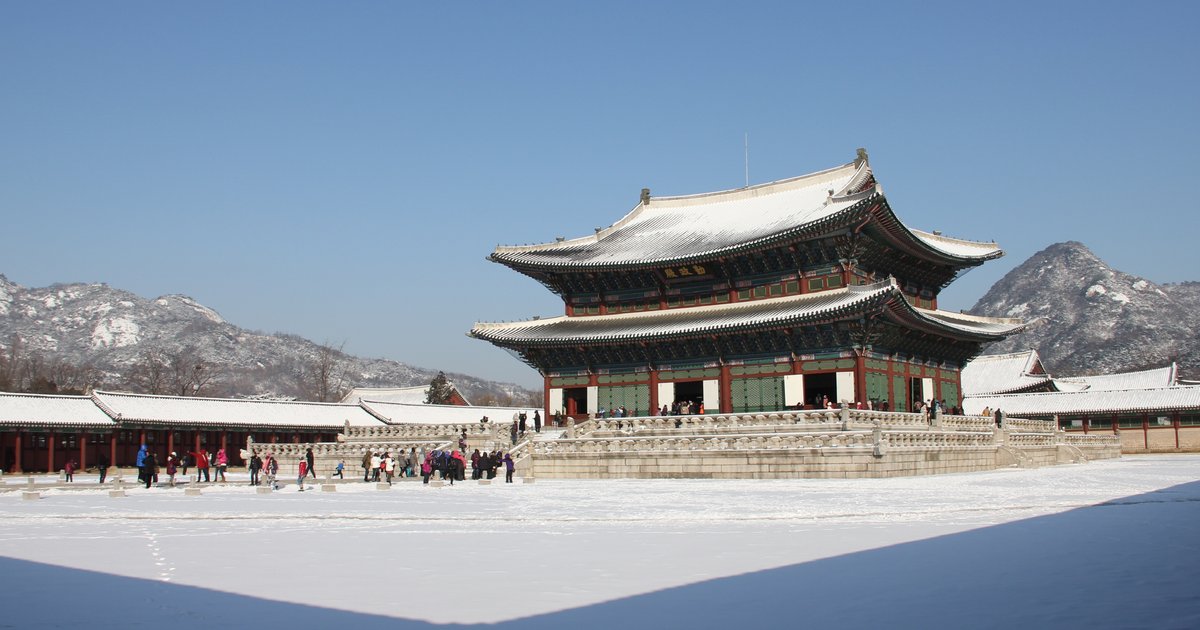
Seoul’s first snow of 2026 fell on November 8, twelve days ahead of the November 20 average. It was sleet and snow pellets, and nothing settled on the ground. So November 8 has already happened, and the useful question now is which week to book. If snow matters to your trip, book January: five days in Seoul in January gives you about a 64% chance of at least one snowy day, but only about 46% of seeing snow on the ground. This guide gives you the odds by month and by half-month, what this winter’s official outlook says, what happens to transport on a heavy-snow day, and whether to count on snow if you are flying in or out of Busan. Two terms run through it: a “snow day” is any day the Seoul weather station records falling snow, sleet included; a “snow-cover day” is a day when fresh snow actually settles and can be measured.
- 2026 first snow: November 8, as sleet and snow pellets. Twelve days early, nothing on the ground.
- Best month: January. Five days give about 64% for snowfall and 46% for snow on the ground; seven days give 74% and 58%.
- Late December is nearly as good: 69% and 44% on a five-day stay starting December 16–31.
- Weak spots: early December and late February, at around 30% for snow on the ground.
- This winter: KMA expects it to start warmer than normal (strong El Niño). It does not forecast snow days.
- Heavy snow day: take the subway; it is the roads that jam.
- Busan: about one day a year with snow on the ground. Put your snow hopes on the Seoul leg.
Contents
- Has Seoul had its first snow in 2026?
- Who this is for
- Key facts
- Which month has the most snow?
- What are my odds on a 5- or 7-day stay?
- Will the snow settle?
- How is Seoul’s “first snow” counted?
- Is this winter forecast to be warm?
- Does heavy snow disrupt transport?
- Flying in or out of Busan: will it snow there?
- How to plan around snow
- Common mistakes
- What I would do
- FAQ
- Official sources
Has Seoul had its first snow in 2026?
Yes, on Sunday, November 8, 2026. That ties with 2002 and 2010 as the third-earliest first snow of the last 31 winters (1996–2026); only 1997 (October 30) and 2006 (November 6) came earlier.
| 2026 first snow | November 8, 2026 |
|---|---|
| Compared with average | 12 days early (average November 20, 1991–2020) |
| Compared with last winter | 26 days earlier than December 4, 2025 |
| What fell | Sleet and snow pellets; nothing settled |
| Last snow of this winter | Not yet (last winter March 6, 2026; average March 18) |
| Earliest and latest on record | October 23, 1981, and December 31, 1948 |
An early first snow tells you little about the rest of the winter. Seoul’s first snow is usually flurries or sleet: November averages only 0.6 days with snow on the ground, and in 19 of the 30 years from 1991 to 2020 November had none at all. In 27 of the last 31 winters the first snow came in November, so an early date is common.
| Winter | First snow | vs. average | Last snow |
|---|---|---|---|
| 2026–27 | Nov 8 | 12 days early | — |
| 2025–26 | Dec 4 | 14 days late | Mar 6 |
| 2024–25 | Nov 26 | 6 days late | Apr 13 |
| 2023–24 | Nov 17 | 3 days early | Mar 7 |
| 2022–23 | Nov 29 | 9 days late | Feb 19 |
| 2021–22 | Nov 10 | 10 days early | Mar 19 |
| 2020–21 | Dec 10 | 20 days late | Mar 2 |
| 2019–20 | Nov 15 | 5 days early | Apr 22 |
| 2018–19 | Nov 24 | 4 days late | Mar 23 |
| 2017–18 | Nov 17 | 3 days early | Apr 7 |
| 2016–17 | Nov 26 | 6 days late | Mar 8 |
| 2015–16 | Nov 25 | 5 days late | Feb 29 |
| 2014–15 | Nov 14 | 6 days early | Mar 3 |
| 2013–14 | Nov 18 | 2 days early | Mar 9 |
| 2012–13 | Nov 13 | 7 days early | Apr 10 |
The last 15 winters. Average first snow November 20, average last snow March 18.
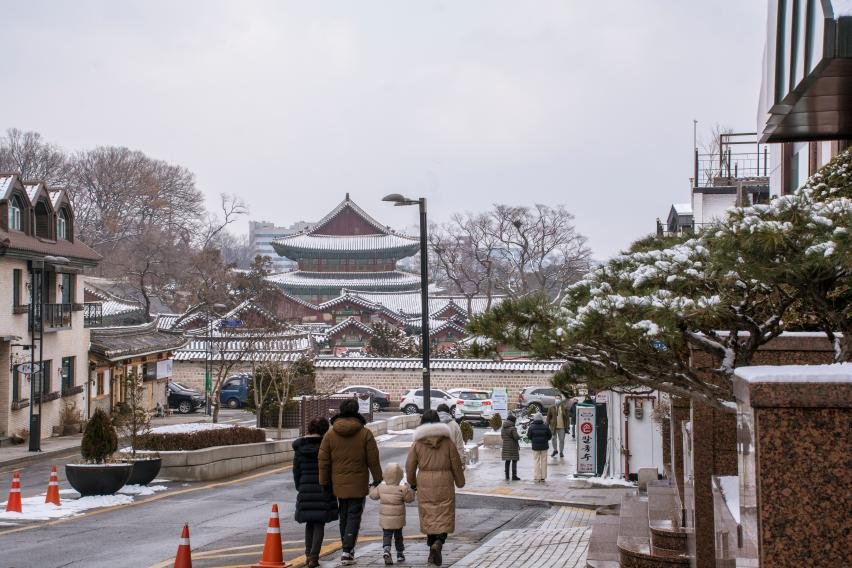
Who this is for
Anyone planning a winter trip to Seoul who would like to see snow.
A good fit if:
- You are still choosing between December, January and February.
- Your dates are fixed and you want to know your realistic odds.
- You worry that a heavy snowfall could wreck a day of sightseeing.
- You are flying in or out of Busan and wondering which half of the trip to bet on.
You can skip it if:
- You must see a white landscape. Seoul’s streets cannot promise that; plan a ski resort or a snow festival day instead.
- You are going in November. Snow on the ground is rare that month, so there is nothing to plan around.
Key facts
| Snow season | Late November to mid-March |
|---|---|
| Average first snow | November 20 (1991–2020) |
| Average last snow | March 18 (1991–2020) |
| Snowiest month | January: 7.1 snow days, 4 snow-cover days on average |
| December–February | 18.6 snow days in total on average |
| Heavy snow (5 cm or more fresh in a day) | About 1.2 days per winter; January has the most (0.53) |
| Where it is measured | The KMA weather station in Songwol-dong, Jongno-gu (station 108) |
Which month has the most snow in Seoul?
January, for both snowfall and snow on the ground. December is second and February a little behind. In the last ten years (2016–2025) all three months averaged roughly one more snow day than the 30-year norm, but the order did not change.
| Month | Snow days | Snow-cover days | Snow days, last 10 years | Years with no snow cover (of 30) |
|---|---|---|---|---|
| November | 2.3 | 0.6 | 2.1 | 19 |
| December | 6.4 | 3.3 | 7.2 | 4 |
| January | 7.1 | 4 | 8.4 | 1 |
| February | 5.1 | 2.6 | 6.2 | 3 |
| March | 2.8 | 1 | 2.1 | 15 |
Averages are 1991–2020; “last 10 years” is 2016–2025.
“7.1 snow days in January” means about one day in four has snow in the air, not a week of steady snowfall. Big snowfalls are rarer still: a fresh 5 cm or more in a single day happens about 1.2 times in an average winter.
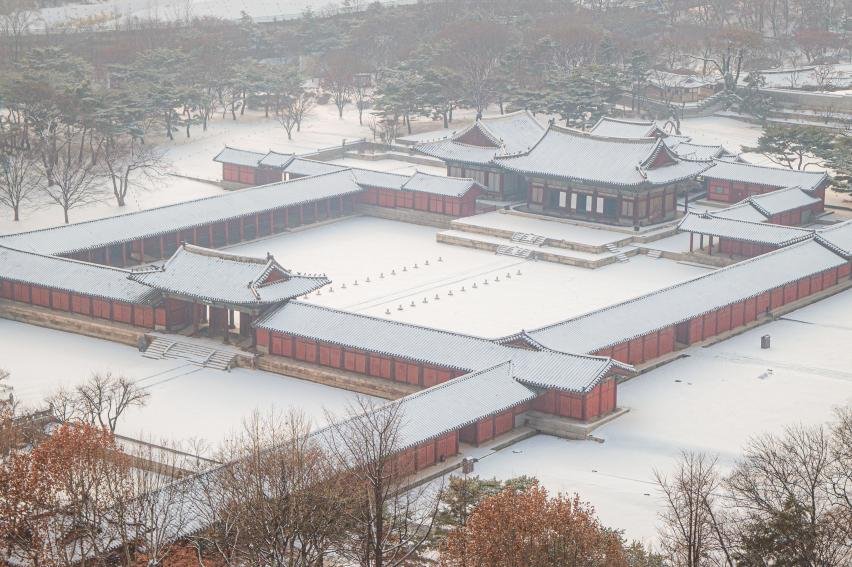
What are my odds of seeing snow on a 5- or 7-day stay?
In January, about 64% over five days and 74% over seven; for snow on the ground, 46% and 58%. These are calculated from KMA’s daily records for 1991–2020: every day of the month is treated as an arrival date, and a stay counts if at least one day in it had snow (or snow cover). Stays that start late in the month run into the next one.
| Arriving in | 1 day: snow | 5 days: snow | 5 days: on the ground | 7 days: snow | 7 days: on the ground |
|---|---|---|---|---|---|
| November | 8% | 27% | 8% | 35% | 12% |
| December | 21% | 62% | 38% | 73% | 48% |
| January | 23% | 64% | 46% | 74% | 58% |
| February | 18% | 55% | 33% | 65% | 42% |
| March | 9% | 29% | 10% | 35% | 13% |
The first and second halves of a month can differ a lot. Early December and late February are the weak spots:
| 5-day stay starting | Snow | On the ground |
|---|---|---|
| Dec 1–15 | 54% | 32% |
| Dec 16–31 | 69% | 44% |
| Jan 1–15 | 63% | 43% |
| Jan 16–31 | 65% | 49% |
| Feb 1–14 | 64% | 38% |
| Feb 15–end | 46% | 28% |
Using only the last ten years (2016–2025), a five-day stay comes out a little better than the 30-year figures: snowfall 70% in December, 70% in January and 63% in February; snow on the ground 39%, 52% and 34%. December and January tie for snowfall, but January still leads clearly for snow that stays.
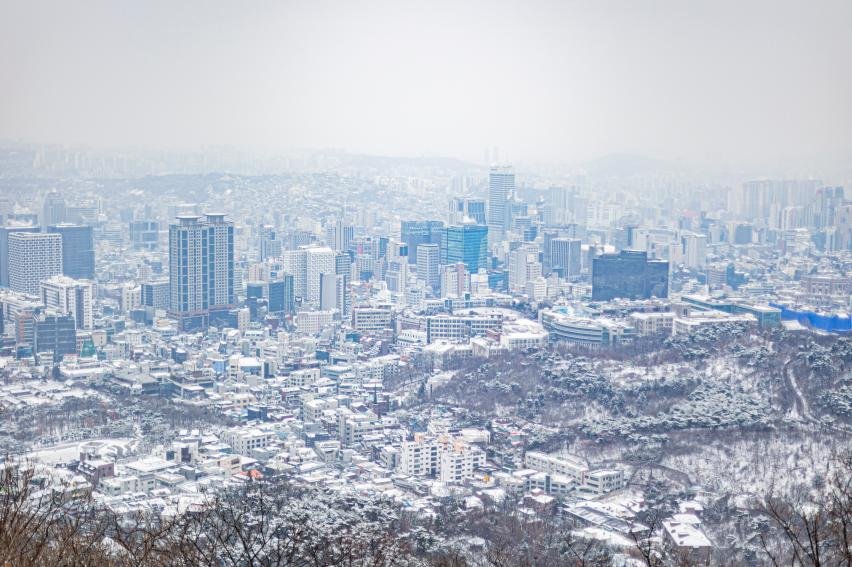
Will the snow settle, or is it just flurries?
Often just flurries. In January only a little over half of the snow days leave snow on the ground. Many snow days are a brief shower that melts on contact, or sleet. Even with the best month and five days, your chance of walking on snow is about one in two.
Individual winters swing widely. This table shows each recent winter’s snow days per month, with snow-cover days in brackets. In December 2019, it snowed on six days and none of it settled; in January 2025, it snowed on 13 days.
| Winter | December | January | February |
|---|---|---|---|
| 2025–26 | 6 (3) | 8 (3) | 3 (1) |
| 2024–25 | 7 (2) | 13 (7) | 5 (3) |
| 2023–24 | 8 (6) | 8 (4) | 10 (7) |
| 2022–23 | 11 (7) | 11 (3) | 3 (0) |
| 2021–22 | 6 (3) | 12 (6) | 6 (2) |
| 2020–21 | 6 (2) | 9 (6) | 5 (3) |
| 2019–20 | 6 (0) | 4 (1) | 9 (3) |
| 2018–19 | 4 (2) | 4 (0) | 8 (4) |
| 2017–18 | 11 (7) | 9 (6) | 6 (3) |
| 2016–17 | 7 (2) | 8 (6) | 3 (0) |
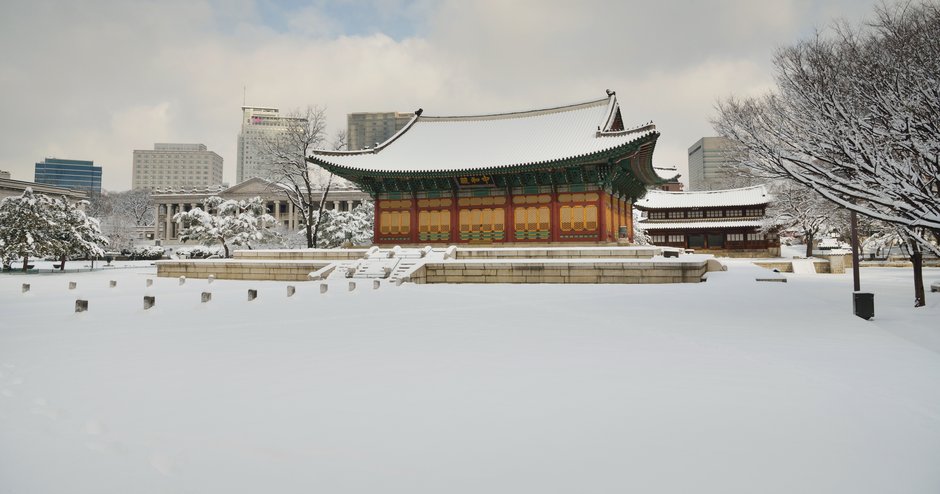
How is Seoul’s “first snow” counted?
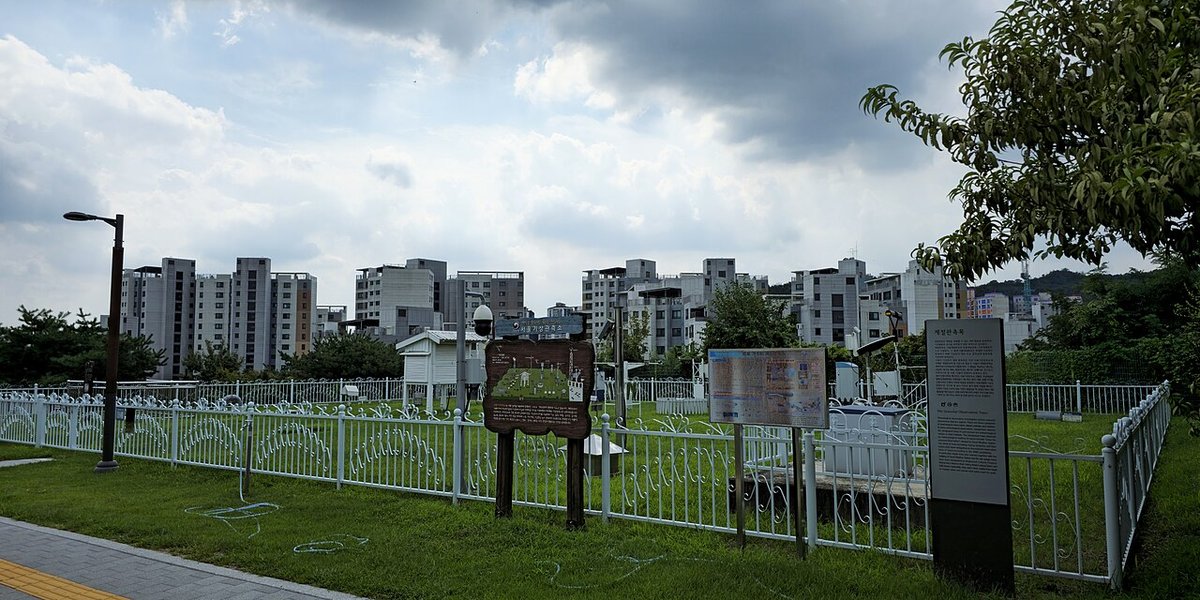
Only snow seen at one station counts: the KMA weather station in Songwol-dong, Jongno-gu. Sleet counts, and nothing has to settle. If it snows in another district first and the station sees nothing, the official first snow has not happened.
| Location | KMA Seoul weather station (station 108), Songwol-dong, Jongno-gu. Observations began in 1907; the station moved to its current site in 1932 |
|---|---|
| Rule | The first day any falling snow is seen on the observation field |
| Sleet | Counts |
| Must it settle? | No |
| Who decides | An observer, by eye |
| Snow elsewhere in Seoul | Does not count if the station did not see it |
Is this winter forecast to be warm in Seoul?
Warmer than normal to start, according to the Korea Meteorological Administration (KMA), because of a strong El Niño expected to peak in December. Warmer doesn’t mean no snow: precipitation is forecast at or above normal. The outlooks cover temperature and precipitation only. They do not forecast snow days or a first-snow date.
3-Month Outlook (Seoul, Incheon, Gyeonggi; issued October 23)
| Month | Average temperature | Precipitation |
|---|---|---|
| November | 60% chance above normal (normal 6.1–7.3°C) | 50% chance above normal |
| December | 50% chance above normal (normal −1.1 to 0.3°C) | 40% normal, 40% above |
| January | 40% normal, 40% above (normal −3.2 to −1.8°C) | 50% chance near normal |
The January note adds a warning: mostly mild, but with low sea ice in the Barents–Kara Sea, brief cold-air outbreaks could bring sharp temperature drops. The next 3-Month Outlook is due November 23.
1-Month Outlook (as of the November 12 outlook)
| Week | Average temperature | Precipitation |
|---|---|---|
| Nov 23–29 | 40% normal (3.1–4.9°C), 40% above | 50% chance above normal (4.4–11.0 mm) |
| Nov 30–Dec 6 | 50% chance above normal (0.8–2.8°C) | 50% chance above normal (1.6–9.3 mm) |
| Dec 7–13 | 50% chance near normal (−0.9 to 1.5°C) | 40% normal (3.0–5.5 mm), 40% above |
| Dec 14–20 | 40% normal (−2.3 to 0.3°C), 40% above | 40% normal (1.2–2.9 mm), 40% above |
KMA updates the 1-Month Outlook every Thursday. If you are going in late November, don’t expect snow on the ground; if a white Seoul is the goal, January is still the bet.
Does heavy snow disrupt transport in Seoul?
The roads jam; the subway keeps running. On a heavy-snow day, switch to the subway. In the storm of November 27, 2024, the Seoul station recorded 19.3 cm of fresh snow in a day, and the city added subway trains while surface traffic crawled. That was the response to one storm, not a fixed rule for every snowfall.
| Heavy Snowfall Advisory (대설주의보) | 5 cm or more of fresh snow expected within 24 hours |
|---|---|
| Heavy Snowfall Warning (대설경보) | 20 cm or more expected within 24 hours (30 cm or more in mountain areas) |
| Subway on November 27, 2024 | Lines 2 and 5–8 added 20 trains in the morning rush and 15 in the evening rush |
| Buses on November 27, 2024 | City buses ran rush-hour service 30 minutes longer (07:00–09:30, 18:00–20:30); 94 routes over routinely closed hill roads could be diverted |
| Live updates | Seoul Metro’s Ttota app (또타지하철), the TOPIS website, and electronic boards at bus stops |
When KMA issues a Heavy Snowfall Advisory or Warning, plan that day around places on the subway. Taxis and buses are what get stuck.
Flying in or out of Busan: will it snow there?
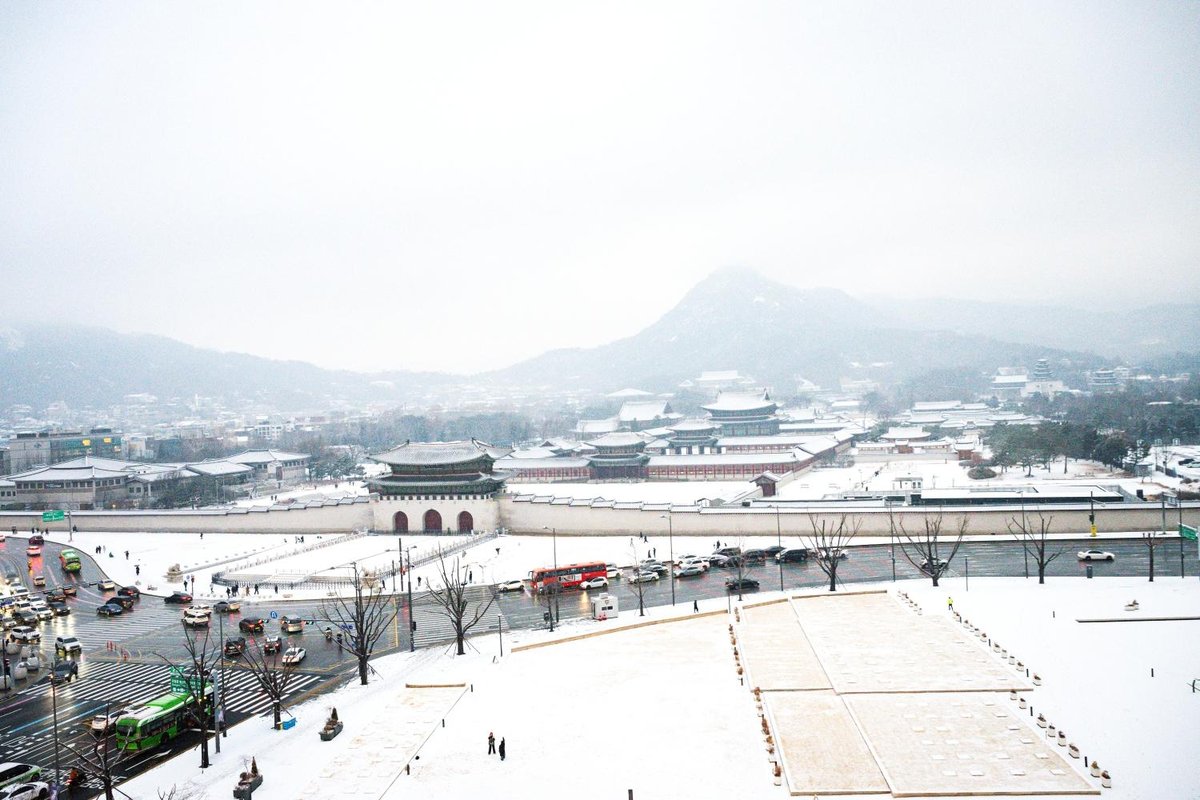
Hardly ever enough to see. Put your snow hopes on the Seoul leg. Busan’s average first snow is December 23, more than a month after Seoul’s. It averages only 0.9, 1.4 and 1.2 snow days in December, January and February, and over the 30 years from 1991 to 2020 it had 29 days with snow on the ground in total, about one a year. As of November 14, 2026, KMA had no record of Busan’s first snow this winter. The odds, the history and the alternatives are in does it snow in Busan.
How to plan around snow
If snow is the main reason and your dates are open
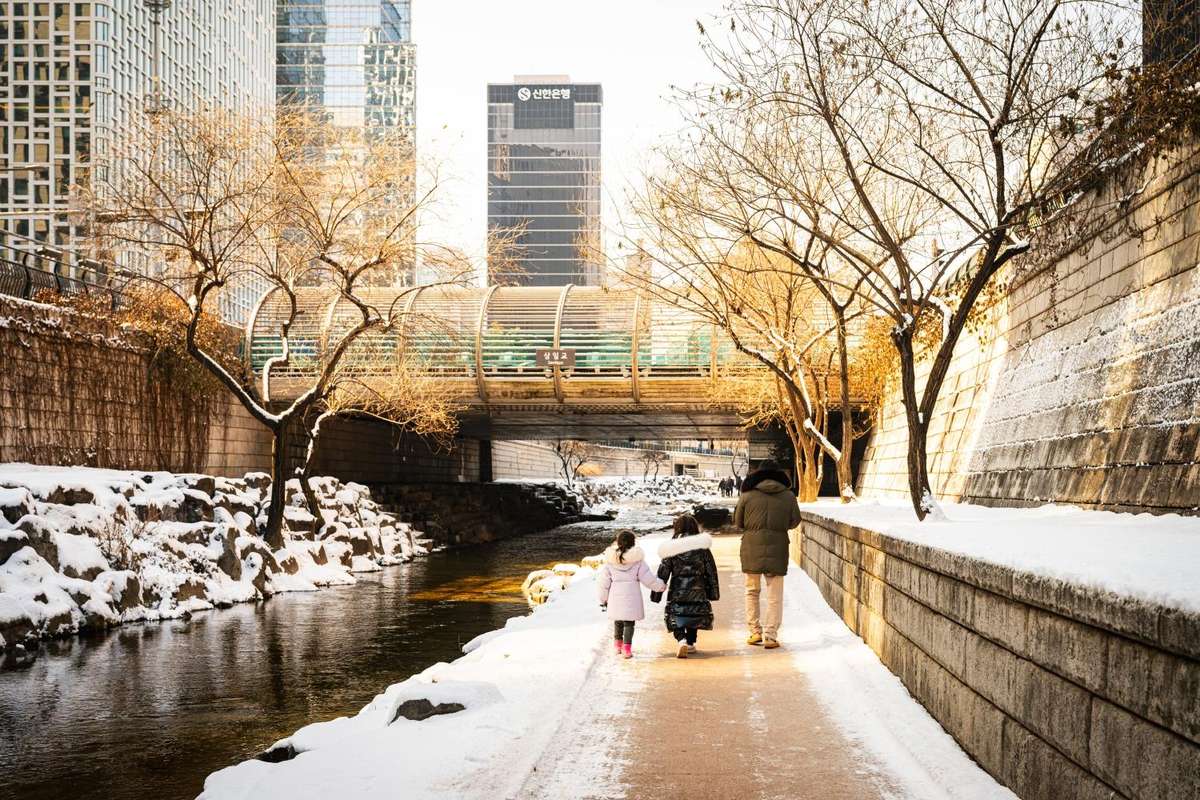
Go in the second half of January and stay seven days. A five-day stay starting January 16–31 has about a 49% chance of snow on the ground, the best half-month in the table; over seven days in January the average is 58%. Leave one day unplanned so you can use a snowy day for a walk through the palaces and along Cheonggyecheon, and keep the original plan if it stays dry.
If you can only go in early December or late February
Five days give roughly a 30% chance of snow on the ground (32% from December 1–15, 28% from February 15). Don’t make snow the goal of this trip. If you want snow underfoot for sure, add a day at a ski resort that is open on your dates.
If you are going over New Year
A five-day stay starting December 16–31 has about 69% for snowfall and 44% for snow on the ground, close to January. There’s no need to move the trip for snow. If you plan to be at Bosingak, Gwanghwamun or DDP at midnight, the last train home matters more than the weather; see Seoul New Year’s Eve: where to go and how to get back.
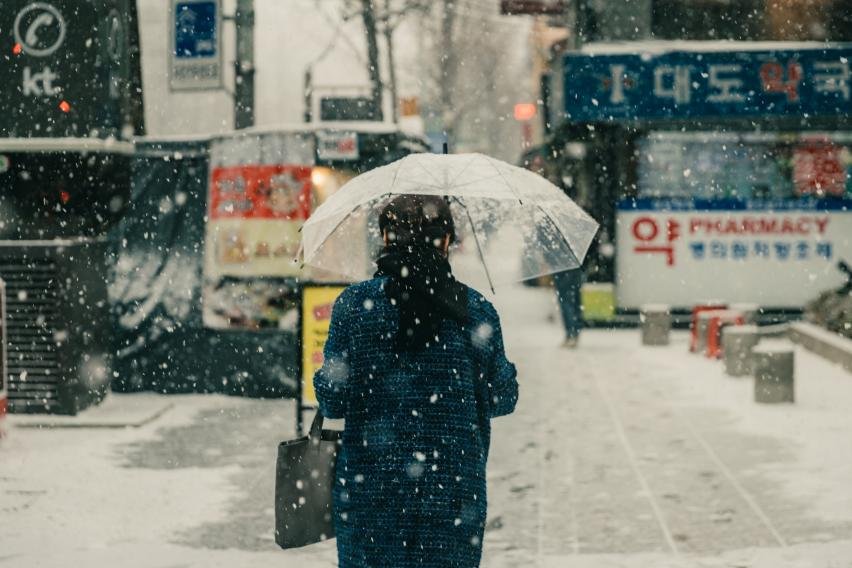
Common mistakes
- Treating snowfall as a snowy landscape. January averages 7.1 snow days, but only 4 with snow that settles.
- Going in November because the first snow has fallen. First snow is usually flurries or sleet; November averages 0.6 days with snow on the ground, and five days that month give 8%.
- Reading “7.1 snow days in January” as a week of snow. That is spread across 31 days.
- Assuming the official first snow has happened because you saw flakes. Only the Songwol-dong station counts.
- Counting on snow in Busan. It averages about one day a year with snow on the ground.
- Taking a bus or taxi on a heavy-snow day. The roads are the bottleneck; the subway is the steady option.
What I would do
I’d book late January and stay seven days. That is the highest-odds combination in the data, and it is still before snow starts thinning out in late February. With only five days, I’d take late December or January over late February.
| When | Arrive between January 16 and 25 |
|---|---|
| Length | Seven days in Seoul |
| Keep free | One unplanned day, used for palaces and Cheonggyecheon if it snows |
| Check | KMA’s Heavy Snowfall Advisories before each day; move to the subway if one is issued |
| Evenings | If the lanterns are still up, the Seoul Lantern Festival on Cheonggyecheon |
If you must see snow, don’t pin it on the city: add a day at a ski resort and treat snow in Seoul as a bonus. If you are flying in or out of Busan, put the Seoul leg in January and plan the Busan days as if there will be no snow.

FAQ
- Q1: Has Seoul had its first snow in 2026?
- Yes, on November 8, 2026, twelve days ahead of the November 20 average. It was sleet and snow pellets, and nothing settled on the ground. Last winter the first snow did not come until December 4, 2025.
- Q2: What month does it snow the most in Seoul?
- January. It averages 7.1 snowy days and 4 days with snow on the ground (1991–2020). December is close behind, February a little lower.
- Q3: Will I see snow in Seoul in December?
- Possibly, and late December is much better than early December. Across the whole month, five days in Seoul give about a 62% chance of a snowy day and 38% of snow on the ground. Starting December 16–31, it rises to 69% and 44%.
- Q4: Is snow guaranteed in Seoul in January?
- No. Five days in January give about a 64% chance of seeing it snow and 46% of seeing it on the ground; seven days give 58% for snow cover. Some Januarys have very little.
- Q5: Does sleet count as first snow in Seoul?
- Yes. KMA counts sleet as snow, and the snow does not have to settle. It only has to be seen at the Seoul weather station in Songwol-dong, Jongno-gu.
- Q6: Is this winter going to be warm in Seoul?
- KMA expects a warmer-than-normal start, because of a strong El Niño. Its outlook covers temperature and precipitation only, not snow days. Warmer does not mean no snow, and precipitation is forecast at or above normal.
- Q7: Does the Seoul subway run during heavy snow?
- Yes. In the November 27, 2024 storm, Seoul added subway trains while surface roads jammed. On a heavy-snow day, switch to the subway.
Official sources
- KMA Open MET Data Portal: seasonal observations (Korean; first and last snow)
- KMA Open MET Data Portal: snow days (Korean)
- Korea Meteorological Administration (English; 1-Month and 3-Month Outlooks)
- KMA: issuance criteria for weather advisories and warnings (English; Heavy Snowfall)
- City of Seoul: public transport response to the November 27, 2024 snowstorm (Korean)
- TOPIS, Seoul traffic information
Weather and transport arrangements follow the latest official announcement.
Read next
Verified
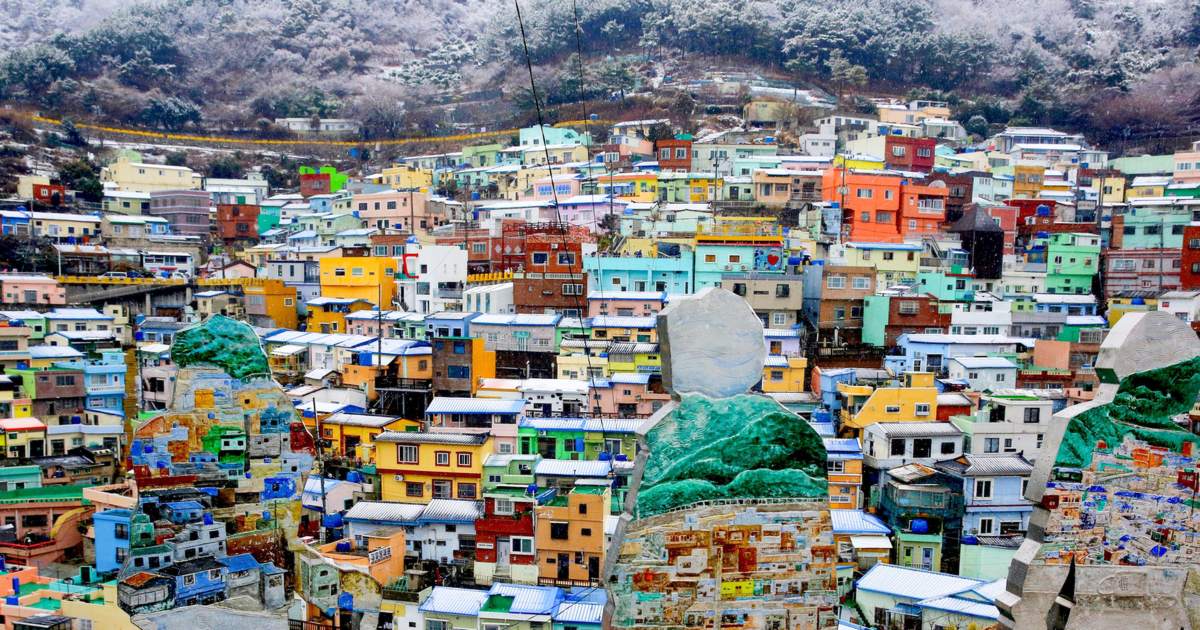 Not announced
Does It Snow in Busan? 2026–27 Odds by Month and First Snow
As of November 14, 2026, KMA had not recorded Busan’s first snow of the 2026–27 winter. The average date is December 23; last winter it came on February 7, 2026, with snow on only 2 days and none settling. January is the best month: about 19% for snowfall and 7% for snow on the ground on a five-day stay.
Verified
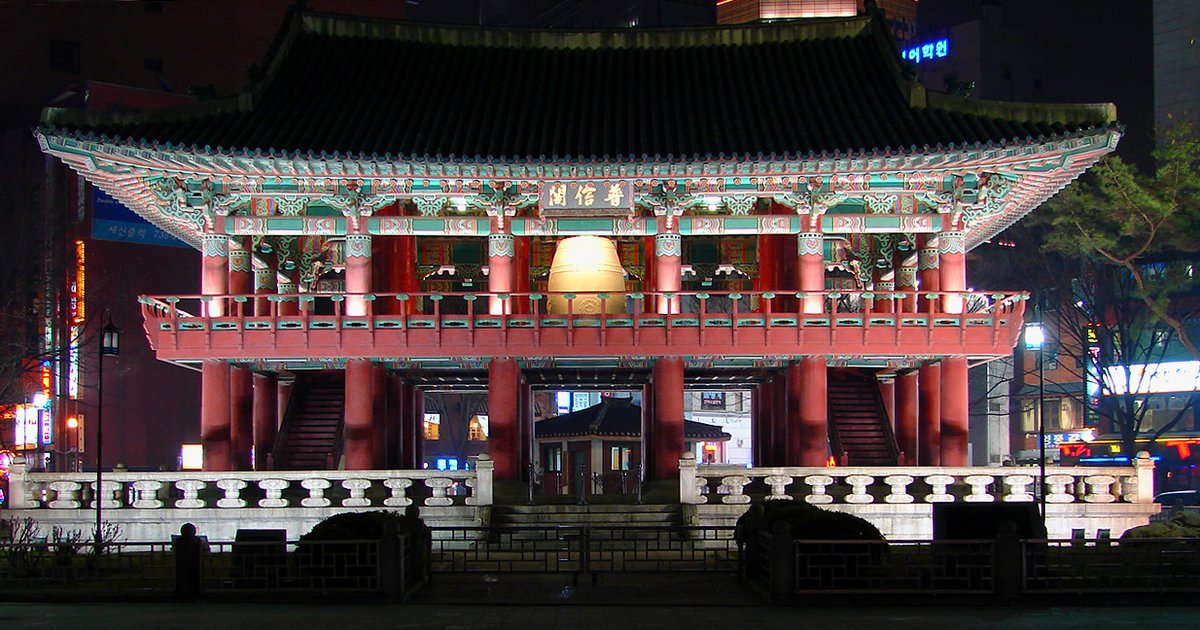 Not announced
Seoul New Year's Eve 2026: Fireworks, Bosingak and Last Trains
Seoul has confirmed the Bosingak bell ringing and a DDP countdown for December 31, 2026; times and transport are not out yet. Last year the bell ceremony ran 22:50–00:20, free, and the subway ran until about 02:00 with trains skipping Jonggak 23:00–01:00.
Verified
 Current
Seoul Lantern Festival 2026: Dates, Hours and Where to Walk
The 2026 Seoul Lantern Festival runs December 11, 2026 to January 31, 2027 on Cheonggyecheon Stream (Cheonggye Plaza to Samilgyo Bridge), daily 18:00–23:00. Free, no reservation.