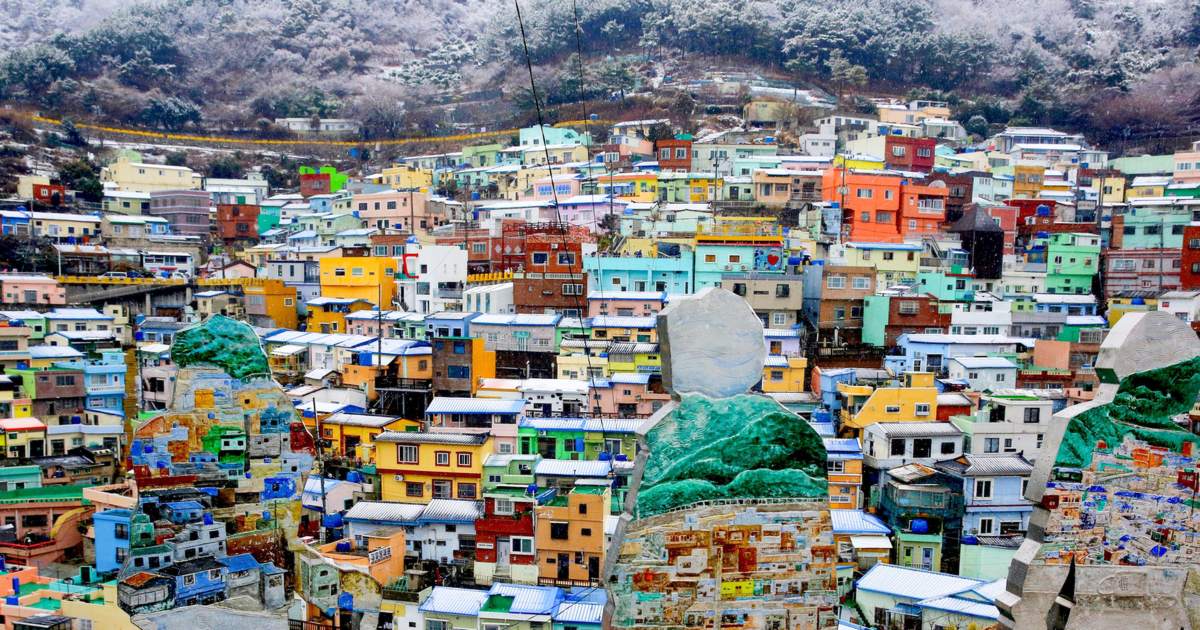
Busan averages 4.2 snow days a year, and fewer than one day a year with snow that actually settles. Even in January, the best month, five days in Busan give you about a 19% chance of seeing snow fall, and over the last ten years only 15%. The last time the city measured 1 cm of snow on the ground was January 10, 2018. So the short version is: don’t plan on Busan snow. Many people assume January or February must bring some; in fact 2 of the last ten winters had none at all. This guide gives the odds by month, this winter’s status and outlook, and where to go if you want snow on a Busan trip. A “snow day” below is any day the Busan weather station records falling snow, sleet included; a “snow-cover day” is a day when fresh snow settles deep enough to measure.
- How often: 4.2 snow days a year; about one day a year with snow on the ground.
- Best month: January, at 19% for snowfall and 7% for snow on the ground on a five-day stay (15% and 3% in the last ten years).
- This winter: no first snow recorded as of November 14, 2026. Normal; the average date is December 23.
- February has faded: 1.2 snow days on the 30-year average, 0.3 in the last ten years.
- Want snow? Put it on a Seoul leg: 70% and 52% in January. Daegu is only 40% and 11%.
- Just want to touch snow? Eden Valley in Yangsan uses machine-made snow, but it hasn’t announced its 2026–27 opening.
Contents
- Has Busan had its first snow this winter?
- Who this is for
- Key facts
- How often does it snow, month by month?
- What are my odds on a 5- or 7-day stay?
- Will it settle?
- Will it snow on Christmas or New Year’s Eve?
- Is this winter forecast to be warm?
- Where to go for snow instead
- Snow for kids near Busan: Eden Valley
- What happens to the subway on a snow day?
- How cold and windy is Busan in winter?
- How to plan by month
- Common mistakes
- What I would do
- FAQ
- Official sources
Has Busan had its first snow this winter?
Not yet. As of November 14, 2026, KMA had not recorded Busan’s first snow of the 2026–27 winter. That’s normal: the average date is December 23, and last winter it didn’t come until February 7.
| 2026–27 first snow | Not recorded as of November 14, 2026 |
|---|---|
| Average first snow | December 23 (1991–2020) |
| Average last snow | February 13 |
| Last winter (2025–26) | First snow February 7, 2026, 46 days late; snow on only 2 days (February 7 and 10), none settling |
Who this is for
Anyone flying in or out of Busan in winter and wondering whether snow is possible.
A good fit if:
- Your dates are fixed and you want realistic odds.
- You are choosing between December, January and February.
- You want snow on this trip and are deciding between Seoul, Daegu or somewhere else.
- You are traveling with children who just want to touch snow.
You can skip it if:
- Snow is only a bonus. Busan’s winter draw is lights and the New Year countdown, not snow.
- You are flying in and out of Seoul. Read Seoul’s first snow and the best month for snow instead.
Key facts
| Snow days per year | 4.2 on average (126 in 30 years) |
|---|---|
| Snow-cover days per year | About 1 (29 in 30 years) |
| Snowiest month | January |
| Winters with no snow, last 10 | 2 (2019–20 and 2021–22), the only two since records began in 1904 |
| Last 1 cm or more on the ground | January 10, 2018, 1.3 cm |
| Last measurable snow cover | November 18, 2023, 0.3 cm |
| Deepest fresh snow, 1991–2026 | March 5, 2005, 29.5 cm (plus 11.9 cm the next day) |
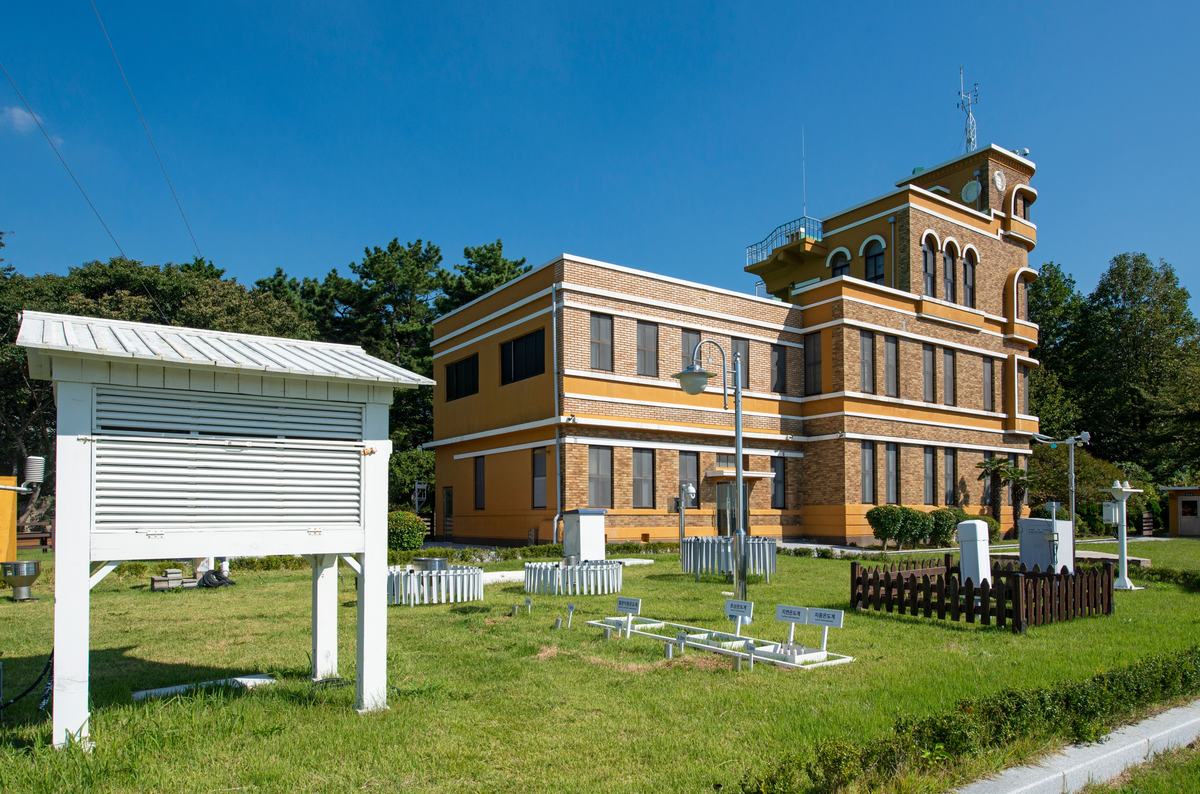
| Where it is measured | The KMA Busan weather station in Daecheong-dong, Jung-gu, about 70 m above sea level |
Busan’s official first snow is whatever that one station sees. If it snows on Geumjeongsan or in Haeundae and the station sees nothing, the news can say there has been no first snow while your friend posts a snowy photo. Both are right.
How often does it snow in Busan, month by month?
January is the most likely month, with 1.4 snow days on average. December and February follow. All three have dropped in the last ten years, February the most, so plan on the last-ten-years column.
| Month | Snow days | Snow days, last 10 years | Snow-cover days | Years with no snow (of 30) |
|---|---|---|---|---|
| November | 0.1 | 0.1 | 0 | 26 |
| December | 0.9 | 0.6 | 0.1 | 10 |
| January | 1.4 | 1.0 | 0.5 | 10 |
| February | 1.2 | 0.3 | 0.2 | 12 |
| March | 0.5 | 0.2 | 0.1 | 21 |
Averages and no-snow years are 1991–2020; “last 10 years” is 2016–2025.
What are my odds of seeing snow on a 5- or 7-day stay?
In January, about 19% over five days and 25% over seven; for snow on the ground, 7% and 9%. The odds come from KMA’s daily records for 1991–2020: every day of the month is treated as an arrival date, and a stay counts if at least one day had snow (or snow cover). Late-month stays run into the next month.
| Arriving in | 5 days: snow | 5 days: on the ground | 7 days: snow | 7 days: on the ground |
|---|---|---|---|---|
| December | 15% | 2% | 21% | 3% |
| January | 19% | 7% | 25% | 9% |
| February | 15% | 4% | 20% | 6% |
The last ten years (2016–2025) are lower in every cell. Across December–February, a five-day stay fell from 17% to 10% for snowfall and from 4% to 1% for snow cover.
| Arriving in (last 10 years) | 5 days: snow | 5 days: on the ground | 7 days: snow | 7 days: on the ground |
|---|---|---|---|---|
| December | 8% | 0% | 12% | 0% |
| January | 15% | 3% | 19% | 5% |
| February | 5% | 0% | 7% | 0% |
Split into half-months (1991–2020), January 16–31 and February 1–14 tie for best at 20%. The February figure leans on older winters, though; in the last ten years all of February dropped to 5%. I’d go with January. Adding two days to a Busan stay barely moves the odds, so spend those days in another city instead.
| 5-day stay starting | Snow | On the ground |
|---|---|---|
| Dec 1–15 | 13% | 0% |
| Dec 16–31 | 18% | 4% |
| Jan 1–15 | 18% | 8% |
| Jan 16–31 | 20% | 6% |
| Feb 1–14 | 20% | 5% |
| Feb 15–end | 10% | 2% |
Will the snow settle in Busan?
Almost never. Expect flurries at best, not a white city. Snow cover averages about one day a year, and the last time it reached 1 cm was January 2018. The table below shows each recent winter’s snow days, with snow-cover days in brackets.
| Winter | December | January | February |
|---|---|---|---|
| 2025–26 | 0 (0) | 0 (0) | 2 (0) |
| 2024–25 | 0 (0) | 1 (0) | 1 (0) |
| 2023–24 | 2 (0) | 0 (0) | 0 (0) |
| 2022–23 | 2 (0) | 0 (0) | 0 (0) |
| 2021–22 | 0 (0) | 0 (0) | 0 (0) |
| 2020–21 | 1 (0) | 2 (0) | 0 (0) |
| 2019–20 | 0 (0) | 0 (0) | 0 (0) |
| 2018–19 | 1 (0) | 1 (1) | 1 (0) |
| 2017–18 | 0 (0) | 2 (1) | 0 (0) |
| 2016–17 | 0 (0) | 2 (0) | 0 (0) |
The deepest fall since 1991 came in March 2005, which shows big snow doesn’t follow the monthly averages. It happened once in 35 years, so it is no basis for a plan.
Will it snow in Busan on Christmas or New Year’s Eve?
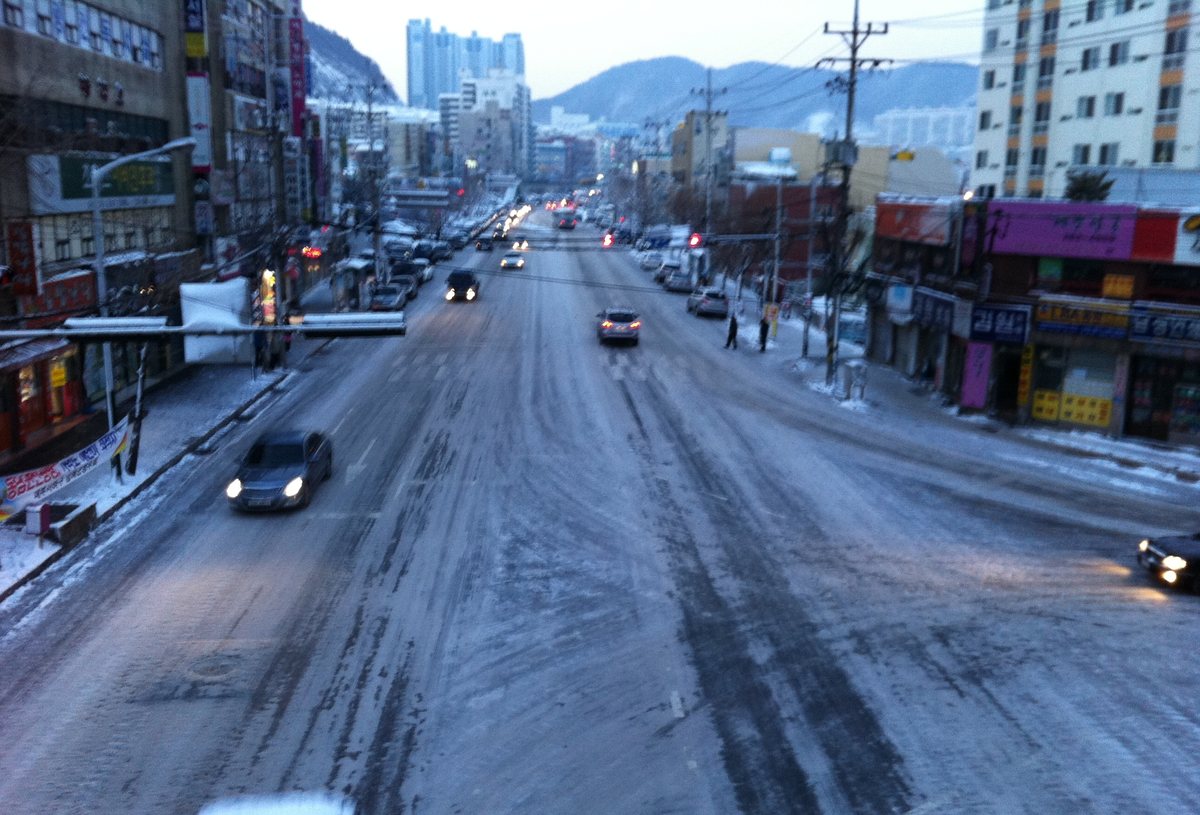
Don’t expect it. In the 35 years from 1991 to 2025, snow fell on Christmas Day in three years and on New Year’s Eve in two.
| Date | Years with snow | Snow on the ground |
|---|---|---|
| December 24 | 1992, 1995, 1999, 2023 | 1992 |
| December 25 | 2000, 2001, 2002 | 2001 (2.2 cm) |
| December 31 | 2004, 2018 | 2004 |
| January 1 | 1997, 2012 | None |
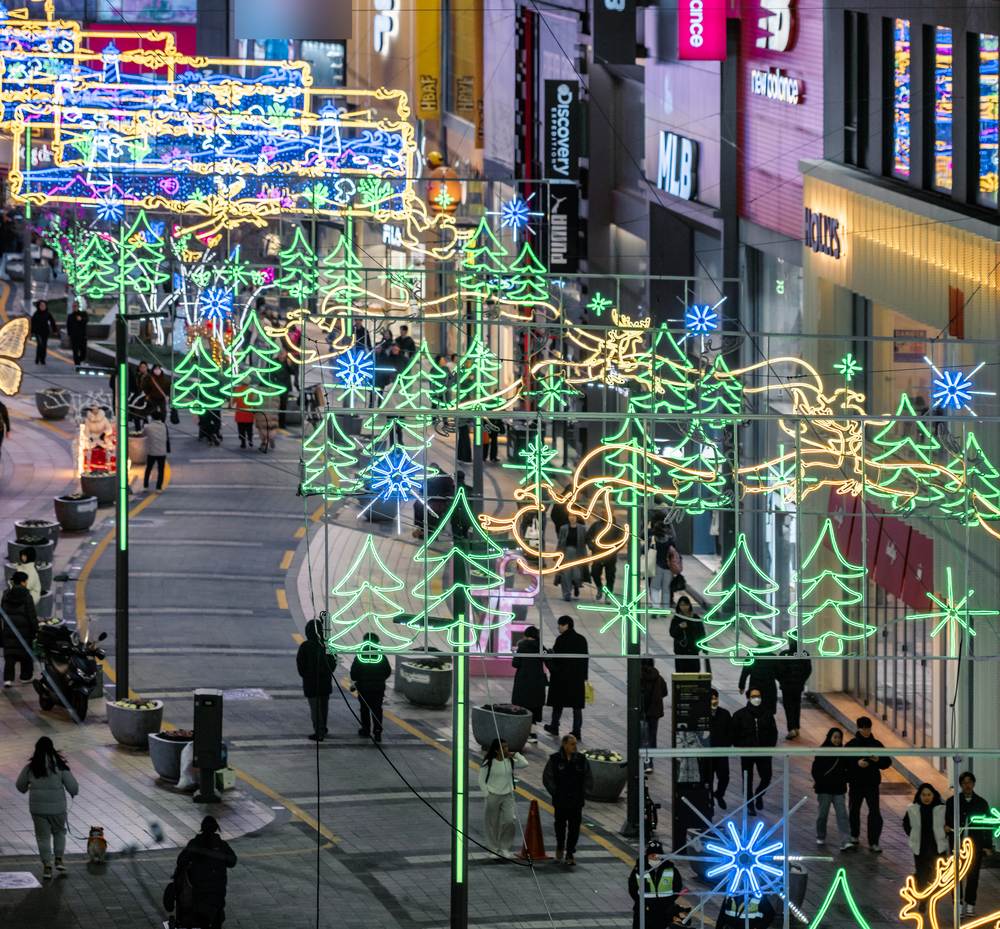
On those nights in Busan you plan around lights and the countdown, not snow. For December 31, see Busan New Year’s Eve: Gwangalli drones or the Yongdusan bell.
Is this winter forecast to be warm in Busan?
Yes. The Korea Meteorological Administration (KMA) expects a warmer-than-normal start because of a strong El Niño, peaking in December. Busan’s January average is already above freezing. The outlooks cover temperature and precipitation only; they don’t forecast snow or a first-snow date.
| 3-Month Outlook (Busan, Ulsan, Gyeongnam; issued October 23) | Average temperature | Precipitation |
|---|---|---|
| November | 60% chance above normal (normal 9.0–10.0°C) | 50% chance above normal |
| December | 50% chance above normal (normal 2.8–4.0°C) | 40% normal, 40% above |
| January | 40% normal, 40% above (normal 1.0–2.0°C) | 40% normal, 40% above |
| 1-Month Outlook (issued November 12) | Average temperature | Precipitation |
|---|---|---|
| Nov 23–29 | 50% chance above normal (6.4–8.0°C) | 50% chance above normal |
| Nov 30–Dec 6 | 50% chance above normal (4.4–6.2°C) | 50% chance above normal |
| Dec 7–13 | 40% normal (3.0–4.8°C), 40% above | 50% chance above normal |
| Dec 14–20 | 40% normal (1.9–3.9°C), 40% above | 40% normal, 40% above |
The 1-Month Outlook is updated every Thursday; the next 3-Month Outlook is due November 23. I wouldn’t change a Busan itinerary for snow this year.
Where should I go for snow instead? Is Daegu any better?
Daegu won’t fix it; Seoul is the bet. Five days in Daegu in January give about an 11% chance of snow on the ground, against 52% in Seoul over the same recent decade. The table shows five-day odds for 2016–2025 as “snowfall / on the ground”, all from city weather stations, not mountains.
| City | December | January | February | Days with 5 cm+ |
|---|---|---|---|---|
| Busan | 8% / 0% | 15% / 3% | 5% / 0% | 0 |
| Ulsan | 17% / 0% | 17% / 5% | 24% / 0% | 0 |
| Changwon | 11% / 0% | 19% / 5% | 11% / 2% | 0 |
| Pohang | 16% / 0% | 21% / 8% | 25% / 9% | 0 |
| Daegu | 28% / 5% | 40% / 11% | 38% / 7% | 2 |
| Jeju City | 42% / 12% | 48% / 24% | 37% / 14% | 8 |
| Andong | 44% / 18% | 51% / 23% | 40% / 20% | 1 |
| Gangneung | 31% / 10% | 43% / 23% | 54% / 31% | 22 |
| Jeonju | 65% / 34% | 65% / 35% | 47% / 29% | 17 |
| Daejeon | 71% / 39% | 70% / 41% | 56% / 27% | 5 |
| Seoul | 70% / 39% | 70% / 52% | 63% / 34% | 11 |
Last column: days with 5 cm or more of fresh snow in December–February, January 2016 to February 2026. Gangneung is the Bukgangneung station; Jeju City is the city station, not the 1100 Highland.
- Seoul is the most practical target from Busan, with the best odds of snow cover in January.
- Gangneung doesn’t beat Seoul on odds, but when it snows it snows deep: 22 days with 5 cm or more, twice Seoul’s count, and 54% for snowfall in February.
- Ulsan, Changwon and Pohang are on Busan’s side of the table, with no 5 cm days at all.
I just want my kids to touch snow near Busan. What are the options?
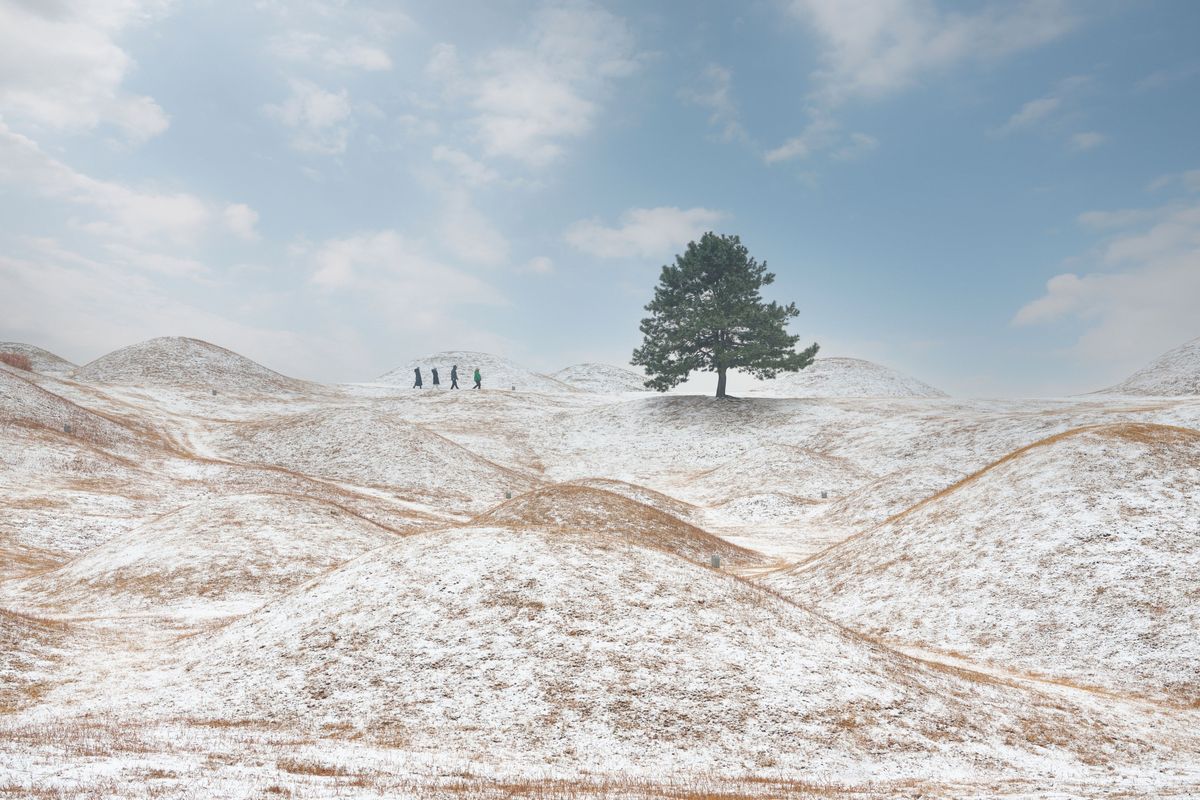
Eden Valley Ski Resort (에덴밸리 스키장) in Yangsan, Gyeongsangnam-do. It’s machine-made snow, and it hasn’t announced its 2026–27 opening yet, so book only after the resort posts its opening notice. If all you want is for the kids to stand in snow, it is more reliable than waiting for Busan weather.
| Location | Yangsan, Gyeongsangnam-do |
|---|---|
| Snow | Mostly machine-made |
| 2026–27 season | No opening notice on the resort’s notice board as of November 14, 2026; the latest post is last season’s closing notice (ended March 1, 2026) |
| Past openings | December 24, 2025; December 20, 2024 |
| Don’t plan on it before | December 20, going by past seasons |
| Getting there | KKday, Klook and Trip.com all sell day tours from central Busan marked “Official”, each with a shuttle-only option |
| Free cancellation | KKday 2 days ahead; Klook 24 hours ahead; Trip.com by 09:00 the day before |
| Klook pickup (English page) | 08:20 KTX Busan Station Exit 1 (the rail station, not the subway); 08:40 Seomyeon Station Exit 12; 09:20 Haeundae Station Exit 5. Back 18:10 Haeundae, 19:00 Seomyeon, 19:20 Busan Station |
The platforms open dates from December 20, 2026. Those are dates the platforms set, not an opening announced by the resort, so wait for the resort’s notice. Non-skiers on the shuttle option go with the ski group to the rental shop and wait while skiers change, and KKday’s shuttle option covers the round-trip ride only, not resort admission. KKday’s page also says “this year, only beginner slopes are open” without saying which season it means.
Once the resort posts its opening, compare the two listings: KKday: Eden Valley ski day tour from Busan → / Klook: Eden Valley ski day tour from Busan →
What happens to the Busan subway on a snow day?
Busan Metro added trains in the 2010 and 2011 snowfalls. On a snowy day I’d take the subway. In 2011 the above-ground sections ran in manual mode at reduced speed, so allow extra time on those.
| March 10, 2010 (Heavy Snowfall Advisory) | 60 extra trains through the day; 5.4 cm of fresh snow |
|---|---|
| February 14, 2011 (Heavy Snowfall Advisory) | 40 extra trains (20 each rush hour), 20 more the next morning; 7.0 cm of fresh snow |
| Slower above-ground sections in 2011 | Line 1 Gyodae–Dusil, Line 2 Geumgok–Yangsan, Line 3 Gupo–Daejeo |
| Winter plan set in November 2024 | Up to 80 extra trains a day in snow, and up to 180 extra station staff |
| March 17, 2025 | The city activated stage 1 of its snow response; on March 18 the station recorded snowfall but no snow cover |
That 2025 case is worth remembering: an emergency text on your phone does not mean the city has turned white.
How cold and windy is Busan in winter?
Milder than Seoul, but windier. Busan in January averages 3.6°C against Seoul’s -1.9°C, and gets about twice Seoul’s precipitation, yet only a fifth of its snow days. Temperature makes the difference: Busan’s January nights hover around freezing, while Seoul’s average low is -5.5°C.
| Mean | High | Low | Precipitation | Wind | Sunshine | |
|---|---|---|---|---|---|---|
| Busan, December | 5.8°C | 10.4°C | 2°C | 33.8 mm | 3.3 m/s | 205.6 h |
| Busan, January | 3.6°C | 8.2°C | -0.1°C | 34.5 mm | 3.5 m/s | 203.1 h |
| Busan, February | 5.4°C | 10.2°C | 1.5°C | 49.6 mm | 3.5 m/s | 189.4 h |
| Seoul, January | -1.9°C | 2.1°C | -5.5°C | 16.8 mm | 2.3 m/s | 169.6 h |
1991–2020 monthly averages.
How to plan by month
If you are going in December and your flights are booked
Write off Busan snow: the last ten years give 8% for snowfall and 0% for snow on the ground on a five-day stay. If you want snow, add a Seoul leg, where the same stay gives 70% and 39%. If you’d rather not travel and you are there after December 20, check whether Eden Valley has opened.
If you are going in January and will take a train
I’d choose Seoul over Gangneung: five days in January give 52% for snow on the ground in Seoul and 23% in Gangneung. Gangneung’s strength is depth when it does snow, but first you need it to snow.
If you are going in February
Busan has almost nothing this month: 5% for snowfall and 0% for snow cover in the last ten years. Seoul (63% / 34%) and Gangneung (54% / 31%) are close, and in February I’d pick Gangneung: heavier snow, plus the east coast.
Common mistakes
- Reading “1.4 snow days in January” as every year. In 10 of the 30 years from 1991 to 2020, January had none.
- Expecting more snow after the first one. Last winter Busan had two snow days in total, three days apart.
- Applying five-day odds to a one-day visit. One day in January gives about 5%.
- Treating any snow day as a snowy scene. Sleet and snow pellets count as snow days.
- Booking Eden Valley before the resort announces its opening. Platform dates are not the resort’s opening date.
What I would do
Seven days, flying in and out of Busan, arriving mid-to-late January: I’d bet all the snow on a Seoul leg and plan the Busan days as if there will be none.
| Days 1–2 | Busan. Plan without snow; if it comes, it is a bonus |
|---|---|
| Day 3 | Morning KTX to Seoul, afternoon in Seoul |
| Days 4–5 | Seoul. Leave half a day free for a walk if it snows |
| Day 6 | Morning in Seoul, evening KTX back to Busan |
| Day 7 | Fly out of Busan (Gimhae) |
That gives Seoul fewer than five days, so your odds are a bit lower than the table. I accept that rather than stretching the trip for snow. In January a single day in Seoul has a better chance of snow than a single day in Busan, so every day you move there helps more than another day waiting in Busan. With children who only want to touch snow, I’d add Eden Valley once it opens; if snow is just a bonus, I’d change nothing.
FAQ
- Q1: Does it snow in Busan in winter?
- Yes, but rarely. Busan averages 4.2 snow days a year and about one day with snow on the ground. In the last ten winters, 2 had no snow at all.
- Q2: Does it snow in Busan in December?
- Very rarely. Over the last ten years, a five-day stay in December had about an 8% chance of seeing snow fall and 0% of seeing it on the ground. The average first snow is December 23.
- Q3: Does it snow in Busan in January?
- January is the best month, and still under one in five. Five days give about 19% for snowfall and 7% for snow on the ground (1991–2020); the last ten years give 15% and 3%.
- Q4: Has Busan had its first snow this winter?
- Not as of November 14, 2026. That is normal: the average date is December 23, and last winter the first snow came on February 7, 2026.
- Q5: Will it snow in Busan on Christmas?
- Almost certainly not. From 1991 to 2025 it snowed on December 25 in only three years (2000, 2001, 2002), and settled once.
- Q6: Where can I see snow near Busan? Is Daegu any better?
- Daegu won’t fix it; Seoul is the bet. Over the last ten years, five days in January gave about 11% for snow on the ground in Daegu and 52% in Seoul. If the kids just want to touch snow, Eden Valley in Yangsan has machine-made snow; see that section.
- Q7: Does the Busan subway run when it snows?
- Yes. In the 2010 and 2011 snowfalls, Busan Metro added trains. Above-ground sections ran slower in 2011; see the subway section.
Official sources
- KMA Open MET Data Portal: seasonal observations (Korean; first and last snow)
- KMA Open MET Data Portal: snow days (Korean)
- KMA Open MET Data Portal: climate normals (Korean)
- Korea Meteorological Administration (English; 1-Month and 3-Month Outlooks)
- City of Busan: March 17, 2025 snow response (Korean)
- Eden Valley Ski Resort (Korean; opening notices)
Weather, transport and resort openings follow the latest official announcement.
Read next
Verified
 Current
Seoul First Snow 2026: Nov 8, and the Best Month for Snow
Seoul’s first snow of 2026 fell on November 8, 12 days ahead of the November 20 average; it was sleet and snow pellets and nothing settled. January is the best bet: five days give about a 64% chance of a snowy day and 46% of snow on the ground.
Verified
 Not announced
Busan New Year's Eve 2026: Fireworks, Drones and Last Trains
The Yongdusan bell-tolling ceremony is listed for December 31, 2026 to January 1, 2027; times, the crowd cap, the Gwangalli drone countdown and subway extensions are not out yet. Last year Gwangalli had a 2,500-drone countdown at midnight and Yongdusan rang the bell at 00:00 with a 7,000-person cap; both free, no booking.
Verified
 Not announced
Seoul New Year's Eve 2026: Fireworks, Bosingak and Last Trains
Seoul has confirmed the Bosingak bell ringing and a DDP countdown for December 31, 2026; times and transport are not out yet. Last year the bell ceremony ran 22:50–00:20, free, and the subway ran until about 02:00 with trains skipping Jonggak 23:00–01:00.