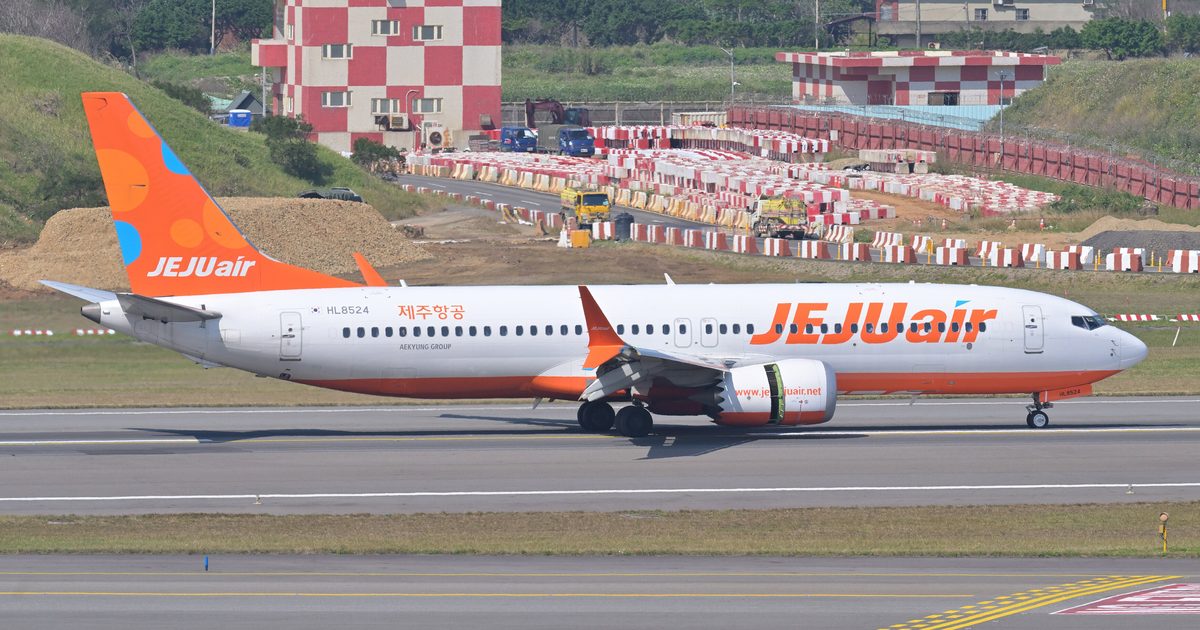
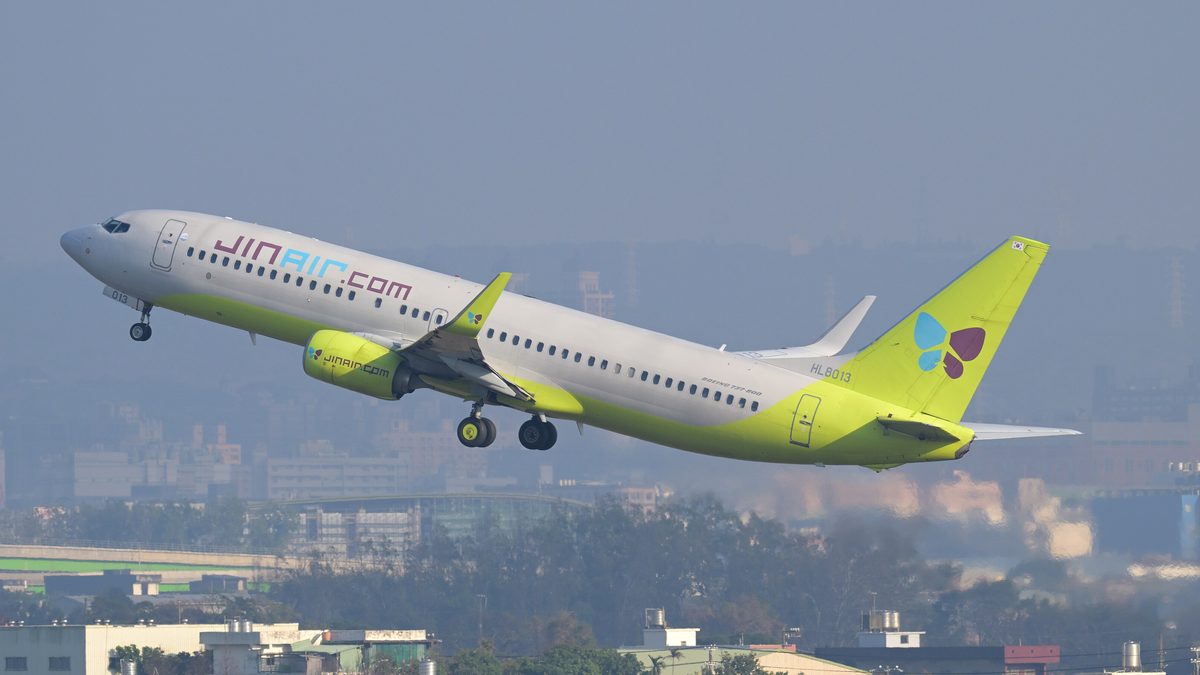
All five Korean low-cost carriers, Jeju Air, Jin Air, Air Busan, Eastar Jet and Trinity Airways (the new name of T’way Air since September 10, 2026), allow 10 kg of carry-on in economy on international flights. The differences are elsewhere. Jeju Air, Trinity and Jin Air count your duty-free bag inside that 10 kg. Four of the five sell a cheapest fare with no checked bag at all; only Jin Air includes 15 kg on every fare on its Asian routes. And Jeju Air caps a checked suitcase at 158 cm in total dimensions, where the others allow 203 cm. The rules below are airline rules, the same whatever your passport, and they cover flights to and from Korea on these airlines’ Asian routes, with Guam, Saipan and other exceptions marked.
- Carry-on: 10 kg on all five; Jin Air allows 12 kg on a few routes.
- Duty-free counts toward the 10 kg on Jeju Air, Trinity and Jin Air.
- No checked bag on Jeju Air BASIC, Trinity Event, Air Busan special/event and Eastar special fares (international).
- Jin Air includes 15 kg on every fare on Japan, China, Hong Kong, Taiwan and Southeast Asia routes.
- Biggest checked bag: 158 cm on Jeju Air; 203 cm on the other four (158 cm on Guam/Saipan).
- Overweight carry-on at the boarding gate: ₩20,000 to ₩50,000 for the first piece, more on some airlines; check it at the counter instead.
Contents
- Who this is for
- The five airlines at a glance
- Is T’way the same as Trinity Airways?
- Does the cheapest fare include a checked bag?
- Carry-on: how many bags, how heavy?
- Does a duty-free bag count?
- Overweight carry-on at the boarding gate
- Checked bag size and weight limits
- Can companions combine allowances?
- Prepay online or pay at the airport?
- Your situation
- Common mistakes
- What I would do
- FAQ
- If it were me
- Official sources
Who this is for
Travelers flying a Korean low-cost carrier on an international route who want to know what fits in the fare before paying for extras.
- You’re comparing a BASIC or special fare against the next fare up and need to know whether a checked bag is included.
- You plan to shop at duty-free and want to know whether that bag will push you over 10 kg.
- You’re traveling with family or friends and want to share one checked allowance.
- You booked T’way and your confirmation now says Trinity Airways.
You can skip it if:
- You’re only flying within Korea. Domestic allowances can differ (Eastar’s special fare includes 15 kg domestically but not internationally); see Korean domestic flight rules.
- You’re flying Korean Air or Asiana, which are full-service carriers with their own rules.
The five airlines at a glance
Same 10 kg carry-on, different everything else. Economy, international routes in Asia; exceptions are in the sections below.
| Cheapest fare: checked bag | Duty-free inside 10 kg | Max checked piece | |
|---|---|---|---|
| Jeju Air (7C) | None (BASIC) | Yes | 158 cm, 32 kg |
| Trinity Airways (TW) | None (Event) | Yes | 203 cm, 32 kg |
| Jin Air (LJ) | 15 kg on every fare | Yes | 203 cm, 32 kg |
| Air Busan (BX) | None (special/event) | Not mentioned | 203 cm, 32 kg |
| Eastar Jet (ZE) | None (special; some promotions include it) | Small amount allowed extra | 203 cm, 32 kg |
Is T’way Air the same airline as Trinity Airways?
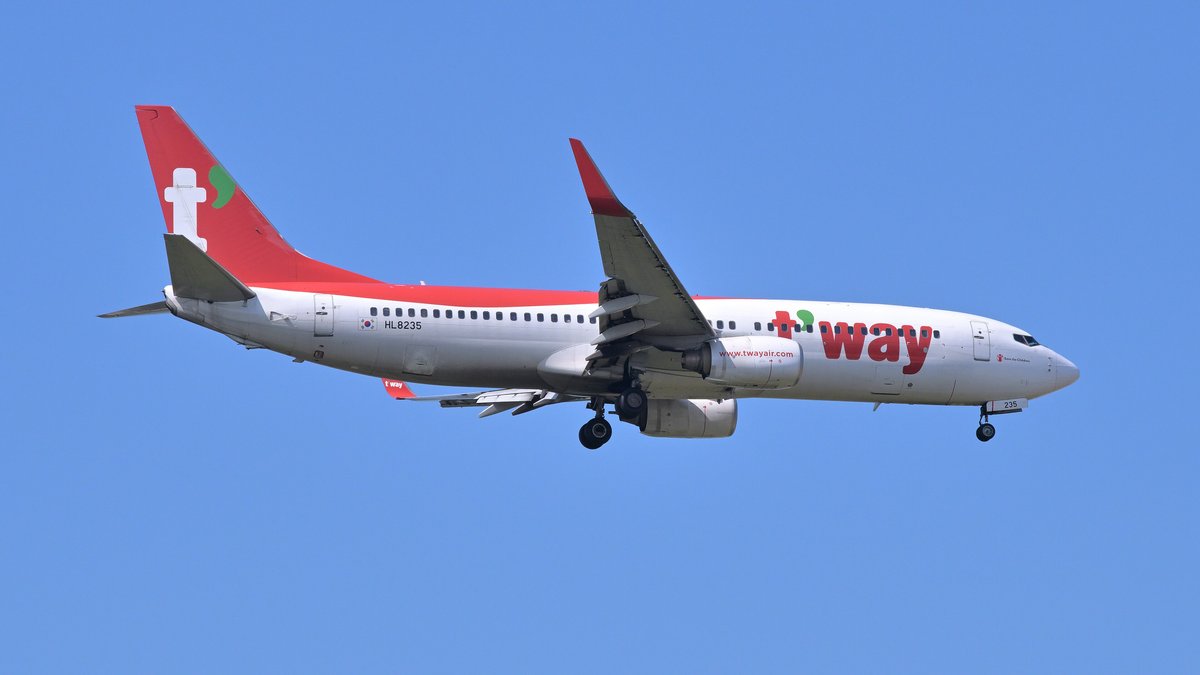
Yes. T’way Air (티웨이항공) renamed itself Trinity Airways (트리니티항공) and began using the new name on September 10, 2026. The flight code stays TW, so a booking made under the old name is still valid. The new livery started with a Boeing 737-8 on the Gimpo–Jeju route and is being rolled out gradually, which is why you can still see red-tailed t’way planes at the airport. The website is now trinityairways.com, and twayair.com redirects there.
| Official name | Trinity Airways (트리니티항공) |
|---|---|
| Former name | t’way / T’way Air (티웨이항공) |
| Flight code | TW, unchanged |
| New name in use from | September 10, 2026 |
| Website | trinityairways.com (twayair.com redirects) |
Does the cheapest fare include a checked bag?
Only on Jin Air. Jeju Air BASIC, Trinity Event, Air Busan special and event fares, and Eastar special fares carry no free checked bag on international routes (Eastar includes one on some promotions). Jin Air gives 15 kg whatever fare you buy on its Japan, China, Hong Kong, Taiwan and Southeast Asia routes. If you’re checking a suitcase anyway, compare the cheapest fare plus prepaid baggage against the next fare up before you book.
| Airline and routes | Free checked baggage by fare |
|---|---|
| Jeju Air, international except Guam/Saipan | BASIC: none · STANDARD: 15 kg · BIZ LITE: 30 kg |
| Jeju Air, Guam/Saipan | BASIC: none · STANDARD: 1 × 23 kg · BIZ LITE: 2 × 23 kg |
| Trinity, most international routes (Japan, Taiwan, Hong Kong, China, most of Southeast Asia) | Event: none · Smart: 15 kg · Ilban (regular): 20 kg · Business: 30 kg |
| Trinity, Singapore/Jakarta, Europe, Australia (Australia from travel date October 25, 2026) | Event: 15 kg · Smart: 23 kg · Ilban: 23 kg · Business: 40 kg |
| Trinity, Guam/Saipan/Canada | Each economy fare: 1 × 23 kg · Business: 2 × 23 kg |
| Trinity, Mongolia/Uzbekistan (from travel date October 25, 2026) | Each economy fare: 1 × 23 kg · Business: 2 × 23 kg |
| Jin Air, Japan, China, Hong Kong, Taiwan, Southeast Asia | 15 kg on every fare |
| Jin Air, Guam | 2 pieces, up to 23 kg each |
| Air Busan, international except Guam/Saipan | Teukga/event (special): none · Silsok (value) and Ilban (regular): 15 kg |
| Air Busan, Guam/Saipan | Silsok and Ilban: Guam 2 × 23 kg, Saipan 1 × 23 kg · special/event: none |
| Eastar Jet, international | Teukga (special): none, except some promotions · Halin (discount) and Ilban (regular): 15 kg |
The Korean fare names on Air Busan and Eastar are given in romanized form with a rough English meaning; on the booking page you’ll see them as 특가, 실속, 할인 and 일반. Domestic allowances don’t always match: Eastar’s special fare includes 15 kg on domestic flights but nothing internationally.
Carry-on: how many bags, how heavy?
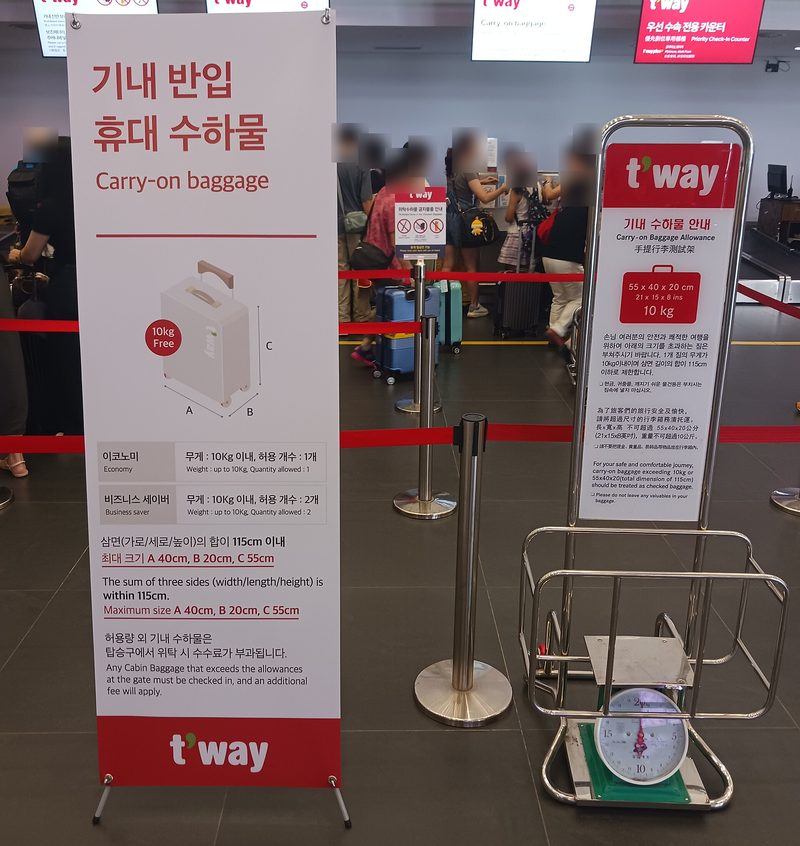
10 kg in economy on all five, with a 115 cm bag (max 40 × 20 × 55 cm) plus a small second item. What the second item can be, and whether it shares the 10 kg, is where they differ. Jeju Air and Trinity count the bag and personal item together; Jin Air and Air Busan set the 10 kg on the main bag and allow one small bag on top.
| Airline | Carry-on rule (economy) |
|---|---|
| Jeju Air | 1 bag + 1 personal item (duty-free included), 10 kg combined. Bag 115 cm, max 40 × 20 × 55 cm; personal item 40 × 30 × 15 cm. Jeju Air’s own example: an 8 kg cabin bag plus a 2 kg duty-free bag is free. |
| Trinity Airways | 1 bag + 1 personal item (duty-free included), 10 kg combined; Business 2 bags, 10 kg each, 20 kg total. Bag 115 cm, max 40 × 20 × 55 cm including wheels and handle; personal item 40 × 30 × 15 cm. |
| Jin Air | 1 bag, 10 kg, 115 cm, max 40 × 20 × 55 cm including wheels and handle, plus one laptop bag, briefcase or handbag (40 × 30 × 15 cm). 12 kg on Incheon–Guam/Phuket and Busan–Guam/Da Nang/Cebu, and on domestic Gimpo, Cheongju, Gwangju and Busan to Jeju. |
| Air Busan | 1 bag, 10 kg, 115 cm, max 40 × 20 × 55 cm including wheels and handle; if any one side is over, it can’t go in the cabin. Plus one laptop bag or small handbag (60 cm total). |
| Eastar Jet | 1 bag, 10 kg, 115 cm total, plus a list of small items you may carry extra, including a small amount of duty-free. |
Air Busan’s rule on single dimensions is strict: a soft bag that’s 115 cm in total but 60 cm tall still fails. Measure the longest side, not just the sum. What can go inside the bag is a separate set of rules; liquids are in Korea’s liquid rules for flights and batteries in the power bank rules.
Does a duty-free bag count toward the carry-on limit?
On Jeju Air, Trinity and Jin Air, yes. On Eastar, a small amount is allowed extra. Air Busan doesn’t say. Duty-free you buy after security goes on the plane with you, so on the first three it eats into the same 10 kg as your cabin bag.
| Airline | What the airline says |
|---|---|
| Jeju Air | Counts: the personal item includes duty-free, 10 kg combined with the bag |
| Trinity Airways | Counts: “1 bag + 1 personal item (duty-free included)”, 10 kg combined |
| Jin Air | Counts: bags over the weight, size or number limits, duty-free included, are checked at the boarding gate for a fee |
| Eastar Jet | “A small amount of duty-free” is on the list of items you may carry in addition |
| Air Busan | Baggage page doesn’t mention duty-free; the only extra item listed is one laptop bag or small handbag |
On Air Busan, I’d treat the duty-free bag as that one small extra item and not count on carrying both. Bottles of alcohol and perfume have their own limits; see whether duty-free alcohol can go in the cabin.
What if my carry-on is overweight at the boarding gate?
It gets checked there, for a fee per piece, and on some airlines a per-kg charge on top. All five tell you to check an oversized or overweight bag at the check-in counter rather than take it to the boarding gate. None of them says every bag is weighed, or that checks are random; plan on being within the limit.
| Airline | Fee for a bag checked at the boarding gate (international) |
|---|---|
| Jeju Air | ₩20,000 / US$20 per piece, paid in the departure country’s currency |
| Trinity Airways | ₩20,000 handling fee per piece, plus excess weight per kg by route; a bag checked at the boarding gate can’t use your free checked allowance |
| Jin Air | 1st piece ₩30,000, 2nd ₩60,000, 3rd ₩90,000; up to 3 pieces per person |
| Air Busan | 1st piece ₩20,000, 2nd ₩100,000 |
| Eastar Jet, Japan routes | ₩30,000 per piece, plus ₩15,000 per kg over 10 kg |
| Eastar Jet, Northeast Asia (China, Taiwan, Hong Kong) | ₩30,000 per piece, plus ₩18,000 per kg over 10 kg |
| Eastar Jet, Southeast Asia and Central Asia | ₩50,000 per piece, plus ₩20,000 per kg over 10 kg |
Eastar’s own example on a Japan route: a 13 kg cabin bag costs ₩30,000 plus 3 kg at ₩15,000, ₩75,000 in all. That’s more than most prepaid checked allowances, so if you’re near the line, check the bag at the counter.
How big and heavy can one checked bag be?
32 kg per piece on all five; 158 cm in total dimensions on Jeju Air, 203 cm on the other four. If your suitcase is large, add up length, width and height before you fly Jeju Air.
| Airline | Limit per checked piece |
|---|---|
| Jeju Air | 158 cm, 32 kg, every route |
| Trinity Airways | 203 cm, 32 kg; Guam/Saipan 158 cm. Over 32 kg must be split into two pieces |
| Jin Air | 203 cm, 32 kg; Guam 158 cm |
| Air Busan | 203 cm, 32 kg; Guam/Saipan 158 cm. Anything bigger or heavier: ask the reservation center first; if it can be carried there’s an extra ₩10,000 fee |
| Eastar Jet | 203 cm, 32 kg |
Can travel companions combine their checked allowance?
Yes on all five, but only for checked baggage, and each airline has its own conditions. Pooling lets one heavy suitcase use a companion’s unused kilos. It never applies to carry-on.
| Airline | Conditions |
|---|---|
| Trinity Airways | Family and travel companions can combine; not on Guam, Saipan, Canada (Vancouver), Mongolia (Ulaanbaatar) or Uzbekistan (Tashkent) |
| Jin Air | Companions on the same flight; each piece within 32 kg; on Guam only the number of pieces is combined |
| Air Busan | Two or more people in the same party, same flight, same destination, checking in together |
| Eastar Jet | Between companions; each piece within 32 kg; you can’t check bags on behalf of someone else |
| Jeju Air | Two or more people checking in together at the same counter, with the same origin and destination; no weight pooling on Guam/Saipan |
The common thread is checking in together. If one of you checks in online and drops bags earlier, the pooling is gone, so go to the counter as a group.
Should I prepay checked baggage or pay at the airport?
Prepay if you know you’ll check a bag; the airport rate is per kg and adds up fast. Prices vary a lot by route, so put your own route into the airline’s baggage price tool before you book.
| Airline | Prepay deadline | How it’s sold |
|---|---|---|
| Jeju Air | 24 hours before departure | Price tool by origin and destination; all international and domestic routes |
| Trinity Airways | 25 hours before departure (buying, changing the weight and canceling) | Price calculator on the website |
| Air Busan | 2 days before departure; from 1 day before, prepaid baggage can’t be refunded | Prepaid in 5 kg blocks; airport in 1 kg steps |
| Jin Air | 4 hours before departure | Prepaid in 5 kg blocks; airport in 1 kg steps |
| Eastar Jet | 24 hours before departure | Airport rate per kg: Japan ₩15,000, Northeast Asia ₩18,000, Southeast and Central Asia ₩20,000. Special fare, 15 kg flat at the airport: Japan ₩60,000, Northeast Asia ₩80,000, Southeast and Central Asia ₩100,000 |
With Air Busan and Jin Air, prepaid baggage comes in 5 kg blocks. If your suitcase is 17 kg on a fare with 15 kg included, you’re buying a 5 kg block for 2 kg, so weigh the case at home and decide whether to move 2 kg into your cabin bag instead.
Your situation
If you’re flying with only a cabin bag and plan to shop at duty-free
Pack the cabin bag to about 7–8 kg on Jeju Air, Trinity or Jin Air, which leaves room for a duty-free bag inside the 10 kg; Jeju Air’s own example is 8 kg plus 2 kg. On Eastar, a small amount of duty-free is allowed extra. On Air Busan, keep the laptop bag or handbag slot free for the duty-free bag.
If you’re on a BASIC or special fare and will check a suitcase
Price the bag on the airline’s site before you book and compare that with the next fare up. If you stay on the cheap fare, prepay before the deadline: 24 hours on Jeju Air and Eastar, 25 hours on Trinity, 2 days on Air Busan.
If you’re a family with one big suitcase and several small ones
Check in together at one counter so the allowances can be combined, and keep every piece under 32 kg. On Jeju Air, also keep the big one within 158 cm. Pooling doesn’t work on Guam or Saipan with Jeju Air or Trinity.
Common mistakes
- Assuming the cheapest fare includes a suitcase. Only Jin Air’s does on its Asian routes.
- Forgetting the duty-free bag. On Jeju Air, Trinity and Jin Air it counts toward the 10 kg.
- Bringing a large suitcase on Jeju Air. The limit is 158 cm in total dimensions on every route.
- Taking an overweight cabin bag to the boarding gate. The first piece there costs ₩20,000–₩50,000, and on Trinity that bag can’t use your free allowance.
- Missing the prepay deadline. Air Busan closes 2 days before departure; Trinity 25 hours.
- Checking in separately and expecting to pool. Most of the five require you to check in together.
- Panicking about the T’way name. Trinity Airways is the same airline, flight code TW.
What I would do
A 5-day trip to Seoul on a Jeju Air BASIC fare, one medium suitcase, some duty-free on the way home:
| When | What |
|---|---|
| Before booking | Price 15 kg in Jeju Air’s baggage tool for both directions, then compare with STANDARD (15 kg included) |
| Packing | Measure the suitcase: length + width + height under 158 cm. Cabin bag around 7 kg |
| By 24 hours before each flight | Prepay the checked bag if staying on BASIC |
| At the airport | Weigh both bags at a public scale before the counter |
| After security, flying home | Keep duty-free to about 2–3 kg so cabin bag plus shopping stays at 10 kg |
I’d run the BASIC-versus-STANDARD comparison first because on a trip with a suitcase, that one choice decides most of the baggage cost.
FAQ
- Q1: Is T’way Air now Trinity Airways?
- Yes, same airline. T’way started using the name Trinity Airways on September 10, 2026; flight numbers still start with TW, and the new livery is going onto the fleet gradually, so you may still board a red-tailed t’way plane.
- Q2: What is the carry-on limit on Jeju Air?
- One carry-on bag plus one personal item, 10 kg combined. The bag can be up to 115 cm in total (max 40 × 20 × 55 cm), the personal item up to 40 × 30 × 15 cm, and duty-free shopping counts toward the 10 kg.
- Q3: Does duty-free count as carry-on on Korean low-cost airlines?
- On Jeju Air, Trinity Airways and Jin Air, yes. Eastar Jet lists a small amount of duty-free as something you may carry in addition; Air Busan’s baggage page doesn’t mention duty-free, so treat the bag as your one small extra item.
- Q4: Does the cheapest Jeju Air fare include checked baggage?
- No. BASIC has no free checked bag on international routes; STANDARD includes 15 kg and BIZ LITE 30 kg (Guam and Saipan use piece allowances instead).
- Q5: How much is it if my carry-on is overweight at the boarding gate?
- The first piece costs ₩20,000 to ₩50,000 depending on airline and route, and Jin Air and Air Busan charge more for a second. Eastar and Trinity add a per-kg charge on top. All five airlines ask you to check an oversized bag at the check-in counter instead.
- Q6: Can two travelers combine their checked baggage allowance?
- Yes on all five, with conditions. You usually have to be on the same flight and check in together, the single-bag limit (32 kg) still applies, and some routes such as Guam and Saipan are excluded.
- Q7: What is the maximum size of a checked bag on Jeju Air?
- 158 cm in total dimensions and 32 kg, on every route. The other four allow 203 cm on most international routes, which matters if you own a large suitcase.
If it were me
Cabin bag only: I’d pick whichever airline is cheapest and pack to 7 kg so duty-free fits. With a suitcase, I’d look at Jin Air first, since every fare on its Asian routes includes 15 kg, and on the others I’d price the next fare up against prepaid baggage before booking. With a large suitcase, I’d measure it against Jeju Air’s 158 cm before choosing Jeju Air. Traveling as a family, I’d always go to the counter together so the allowances combine.
Official sources
- Trinity Airways: baggage (carry-on, checked, pooling)
- Jeju Air: cabin baggage (Korean); prepaid baggage and price tool (Korean)
- Jin Air: free checked baggage; carry-on baggage
- Air Busan: free baggage (Korean)
- Eastar Jet: checked baggage and airport fees (Korean)
Prices and rules follow the latest official announcement.
Read next
Verified
 Current
Jeju Air Cancellation Fee 2026: 5 Korean LCC Refund Fees
Fees are per person, per flight. On tickets from Korea, most fares refund free 91 days or more before departure, while the cheapest fares (Jeju Air BASIC, Jin Air SUPER LOW, Air Busan special, Eastar special, Trinity Event) charge from the day you book, and every fare costs most on the departure day. Eastar changes dates free until 14 days before departure for website and app bookings. All five allow free cancellation within 24 hours of booking, with conditions; a no-show fee is added on top.
Verified
 Current
Incheon Airport Liquids Rule 2026: 100 ml, Kimchi and Soju
On international flights from any Korean airport, carry-on liquids must be in containers of 100 ml or less inside one 1-liter clear resealable bag, one bag per person; Incheon's Smart Security lanes do not relax this. Kimchi and gochujang go in checked bags with no capacity limit. Alcohol over 24% up to 70% is limited to 5 liters per person in checked bags, and over 70% cannot fly. Duty-free liquids can go in the cabin inside the sealed Duty Free Liquid Item Bag, unopened until the final flight.
Verified
 Current
Korea Power Bank Rules 2026: 2 Per Person, 160Wh, Korean Air
Since April 20, 2026, flights departing Korea allow up to 2 power banks per person, each 160Wh or less, in carry-on only; 100–160Wh needs airline approval and still counts toward the 2. Using or charging them on board is banned, and they cannot go in the overhead bin. A 20,000mAh (74Wh at 3.7V) needs no approval; a 30,000mAh (111Wh) does. Asiana flights departing on or after December 17, 2026 are operated by Korean Air under Korean Air flight numbers.